Dental Implants vs Dental Bridges: Which Should You Choose?
| TL;DR Bridges cost £800–£2,500, take 2–3 weeks, and are non-surgical, good if you need a fast, affordable fix. Implants involve minor surgery, but they preserve your jawbone and can last a lifetime. Recovery from a bridge is minimal; implant surgery means 3–5 days of mild swelling. Best for most patients long-term: implants. Best for speed and lower upfront cost: bridges. |
If you’ve recently lost a tooth, you’re probably hearing two options more than any others: dental implants and dental bridges. Both are proven, widely used restorations that can give you back your smile and your ability to chew comfortably. But they work in very different ways, carry different costs, and suit different patients.
At W-Dental, all treatments are performed by GDC-registered dentists, so you’ll always be assessed by a qualified professional who can give you a recommendation based on your actual situation, not a one-size-fits-all script.
What is a dental bridge and how does it work?
A dental bridge is an artificial tooth, called a pontic, held in place by crowns fitted over the teeth on either side of the gap. Those supporting teeth are called abutment teeth. The whole structure is cemented permanently, looks natural, and restores your ability to chew and speak normally.
The key thing to understand is that the bridge is suspended above the gum. It replaces the visible part of your tooth but not the root. That distinction matters more than it might seem, and we’ll come back to it when we discuss bone health.
There are different types of bridges, traditional three-unit bridges, Maryland (resin-bonded) bridges, and cantilever bridges for gaps with only one adjacent tooth. Your dentist will advise which is appropriate for your situation.
How the bridge fitting process works
Bridge treatment is fast and non-surgical. You’ll typically need two appointments. First, the abutment teeth are prepared: a small amount of healthy tooth structure is removed so the crowns can fit over them properly. Impressions are taken and sent to a lab. A temporary bridge is fitted while your permanent one is made, usually over 7–14 days.
At the second appointment, the permanent bridge is checked for fit and bite, then cemented into place. Many patients leave that appointment eating normally the same day.
The speed is a genuine advantage. But there is a trade-off: the abutment teeth are permanently altered. Once that structure is removed, there’s no going back. If oral hygiene around those teeth ever lapses, decay can develop beneath the crowns and compromise the entire bridge.
What is a dental implant and how does it work?
A dental implant is a small titanium post that is surgically placed into the jawbone, acting as an artificial tooth root. Once in place, the bone gradually fuses with the implant in a process called osseointegration. A custom-made crown is then attached on top, giving you a restoration that looks and functions very much like a natural tooth.
Unlike a bridge, an implant doesn’t rely on adjacent teeth at all. Those teeth are left completely untouched. And because the implant sits in the bone, it actually stimulates the jaw the way a real root does, which matters a great deal for long-term bone health.
Osseointegration takes 3–6 months. If your bone density is insufficient, a bone graft may be needed before the implant can be placed, adding further time and cost. This isn’t a reason to avoid implants, but you must go in with realistic expectations.
The implant treatment timeline
Implant treatment happens in distinct phases:
- Consultation and imaging: A CBCT scan (a three-dimensional X-ray) assesses your bone volume and density. Your medical history is reviewed. A treatment plan is agreed.
- Surgical placement: Under local anaesthetic, the titanium post is placed directly into the jawbone. The procedure typically takes 30–60 minutes. Most patients are surprised by how manageable it is.
- Osseointegration: Over 3–6 months, bone fuses with the implant. You won’t feel this happening. You’ll be advised to avoid heavy chewing in that area and to follow a soft diet initially.
- Crown fitting: Once the implant is confirmed as stable, an abutment is attached and a custom crown is fitted on top. You’ll have a final check for bite and aesthetics.
Post-surgery, swelling tends to peak around 48–72 hours and settles significantly by day 4 or 5. Most people are back to light activity within 3–5 days and back to normal function within 1–2 weeks.
Why implants preserve jawbone
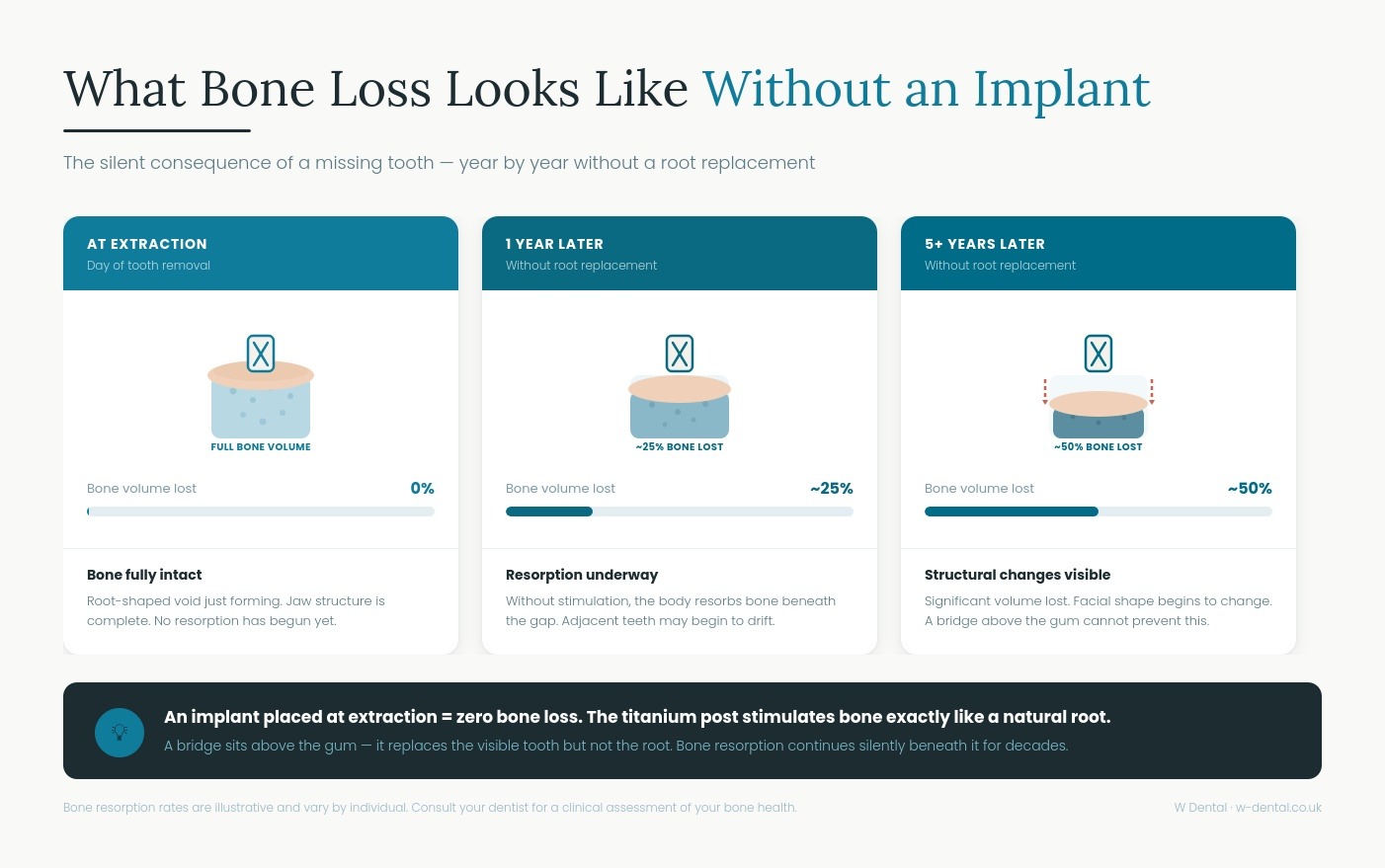
When a tooth is lost, the jawbone underneath it no longer receives any stimulation from chewing. In response, the body gradually resorbs that bone, a process that can result in visible changes to facial shape over years and decades.
An implant embedded in the bone mimics a natural root, transmitting chewing forces into the jaw and preventing resorption. A bridge that sits above the gum does not. This is one of the most clinically significant differences between the two options, and it’s worth taking seriously if you’re thinking about long-term facial structure.
Dental implants vs dental bridge: Side-by-side comparison
| Factor | Dental bridge | Dental implant |
| Treatment time | 2–3 weeks | 3–6 months (longer if bone graft needed) |
| Procedure type | Non-surgical | Surgical (local anaesthetic) |
| Adjacent teeth | Permanently altered | Left completely untouched |
| Bone preservation | Does not prevent bone loss | Stimulates bone; prevents resorption |
| Lifespan | 5–15 years (average ~10 years) | 25+ years; post may be permanent |
| Initial cost (UK) | £800–£2,500 | £2,800–£4,000+ |
| Maintenance | Requires specialist flossing tools | Standard brush and floss |
| Success rate (10+ years) | High with good hygiene | 95–98% with adequate bone |
Cost, longevity, and long-term value
Upfront, a bridge is meaningfully cheaper. A traditional three-unit bridge typically costs £800–£2,500 depending on materials and complexity. A single implant with post, abutment, and crown sits at £2,800–£4,000, rising further if bone grafting is required (typically an additional £500–£2,000).
Bridges typically last around 10 years with good care, though some last longer and some shorter, depending on oral hygiene and the health of the abutment teeth. If you have a bridge replaced twice over 20 years at £1,500 each time, that’s £4,500 total. A single implant at £3,400 with a crown replacement at year 15 (typically £600–£800) works out to roughly £4,000–£4,200 over the same period. The long-term costs are comparable, or the implant may even be lower.
For patients on a tighter budget now, a bridge is a clinically sound option. We’d rather patients have a well-looked-after bridge than an implant they can’t afford to maintain properly. Prices are subject to clinical assessment and may vary. A consultation is always the starting point.
Who is each option best suited to?
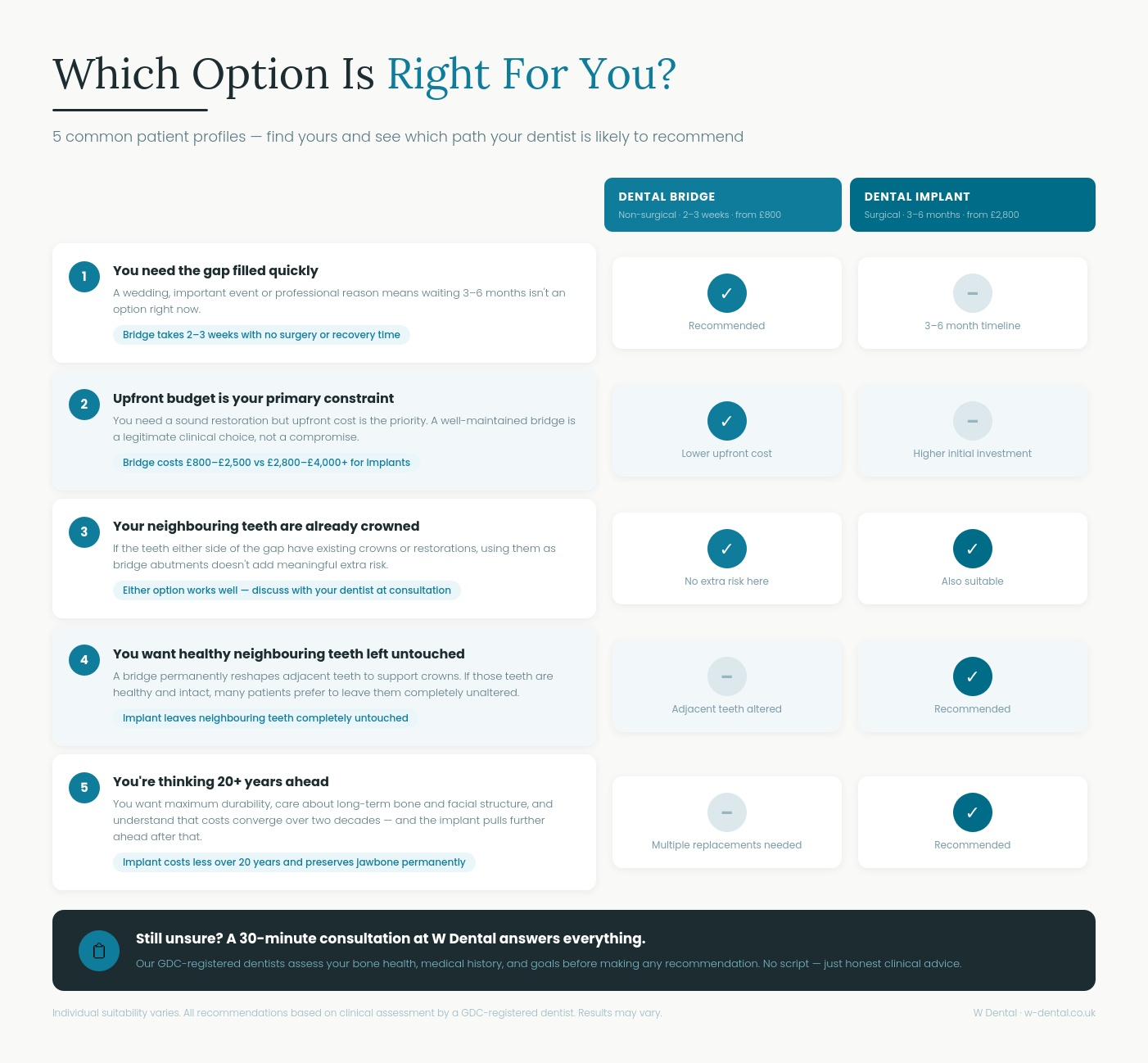
Bridges tend to suit patients who:
- Need a restoration quickly (for work, social reasons, or personal comfort)
- Cannot undergo surgery due to a medical condition affecting healing
- Have insufficient bone volume for an implant and prefer to avoid grafting
- Have neighbouring teeth that are already crowned or heavily restored, supporting a bridge doesn’t add extra risk in this case
- Are working within a tighter budget
Implants tend to suit patients who:
- Want the most durable, long-term solution
- Are concerned about preserving jawbone and facial structure
- Have healthy neighbouring teeth, they don’t want permanently altered
- Are in good general health with adequate bone volume
- Can manage a longer treatment timeline
- Are committed to the maintenance required
At W-Dental, our GDC-registered dentists take the time to assess your bone health, your medical history, and your goals before making any recommendations.
Daily care and maintenance
Both options require consistent oral hygiene. The specifics differ.
For a bridge, standard brushing isn’t enough on its own. You’ll need to clean under the pontic using a floss threader, interdental brushes, or a water flosser. Bacteria and food debris collecting under the bridge are the most common cause of decay in abutment teeth, which can compromise the entire restoration. Done diligently, this adds perhaps two minutes to your daily routine. Neglected, it shortens the bridge’s lifespan considerably.
For an implant, once fully healed, care is much like caring for a natural tooth. Standard floss, a soft toothbrush, and regular professional cleans are sufficient. The main risk to monitor is peri-implantitis, an infection of the tissue around the implant that, if caught early, is manageable. Left untreated, it can lead to implant failure. Six-monthly check-ups are recommended for both restorations.
Smoking affects both, but implants more so: smoking significantly impairs bone healing and increases the risk of implant failure. If you smoke, discuss this honestly with your dentist before committing to either option.
Conclusion
The dental implants vs dental bridge decision doesn’t have a single right answer. Bridges offer speed, a lower upfront cost, and no surgery. Implants offer long-term durability, bone preservation, and a restoration that closely mimics a natural tooth root. Over 20 years, the costs often converge. Over 30 or 40 years, the implant usually comes out ahead on every measure.
What matters is making the decision that fits your clinical situation, your lifestyle, and your budget, with clear information in front of you.
At W-Dental, our GDC-registered dentists offer thorough consultations for both treatments, with transparent pricing and honest timelines. We’ll tell you what we’d recommend and why, and we’ll support whatever decision makes sense for you.
Results may vary. A consultation with your dentist is recommended before any treatment. Prices quoted are indicative ranges and are subject to clinical assessment.
FAQs
Is dental implant surgery painful?
The procedure itself is performed under local anaesthetic, so you shouldn’t feel sharp pain during surgery. Most patients describe pressure sensations rather than pain. Post-op discomfort, some swelling, and mild bruising are normal for 3–5 days and are managed well with over-the-counter pain relief and ice packs.
Can a dental bridge damage my other teeth?
Bridges require the neighbouring teeth to be permanently reshaped to support crowns. This doesn’t damage them outright, but it does make them more vulnerable to decay over time if cleaning around them is inconsistent. If those teeth were already crowned or compromised, the additional risk is lower.
Can I switch from a bridge to an implant later?
Often, yes, but it may be more complex than starting with an implant. Bone loss beneath the bridge gap over the years means grafting may be needed before an implant can be placed. It’s worth having this conversation early, even if you’re choosing a bridge now.
How long does a dental implant last?
The titanium post itself can last a lifetime with proper care. The crown on top is subject to normal wear and may need replacing every 10–15 years. According to the British Dental Association (BDA, 2024), implant success rates at 10 or more years are 95–98% in patients with adequate bone and good oral hygiene.
Are bridges available on the NHS?
Bridges are sometimes available on the NHS where there is a clear clinical need, but this is assessed on a case-by-case basis, and NHS provision is limited. Dental implants are very rarely provided on the NHS. An NHS dentist can advise on your specific eligibility.
How do I know which option is right for me?
A thorough clinical assessment is the only reliable answer. Your dentist will examine your remaining teeth and gums, take X-rays or a CBCT scan, review your medical history, and discuss your priorities and budget. There’s no shortcut to this step, and any practice worth trusting won’t recommend a treatment without it.