Are Dental Implants Worth It? Honest Pros & Cons
| TL;DR Are dental implants worth it? For most patients with good general health and sufficient jawbone, yes. Single implants typically run £1,800–£4,000 in the UK; full-mouth treatment ranges from £12,000–£50,000+. Treatment spans 4–9 months from first consultation to final crown with most patients returning to normal activity within 4–6 weeks of surgery. |
If you are asking whether dental implants are worth it, you are probably weighing a high upfront cost against what could be decades of restored function and confidence. It is a fair question, and one we hear often at W-Dental. The short answer: for most suitable patients, implants are the most durable, health-preserving tooth replacement available.
But “most suitable” is doing a lot of work in that sentence. This guide covers honest costs, real recovery timelines, who makes a good candidate, and where implants genuinely fall short, so you can make an informed decision without the sales pressure.
What are dental implants and how do they work?
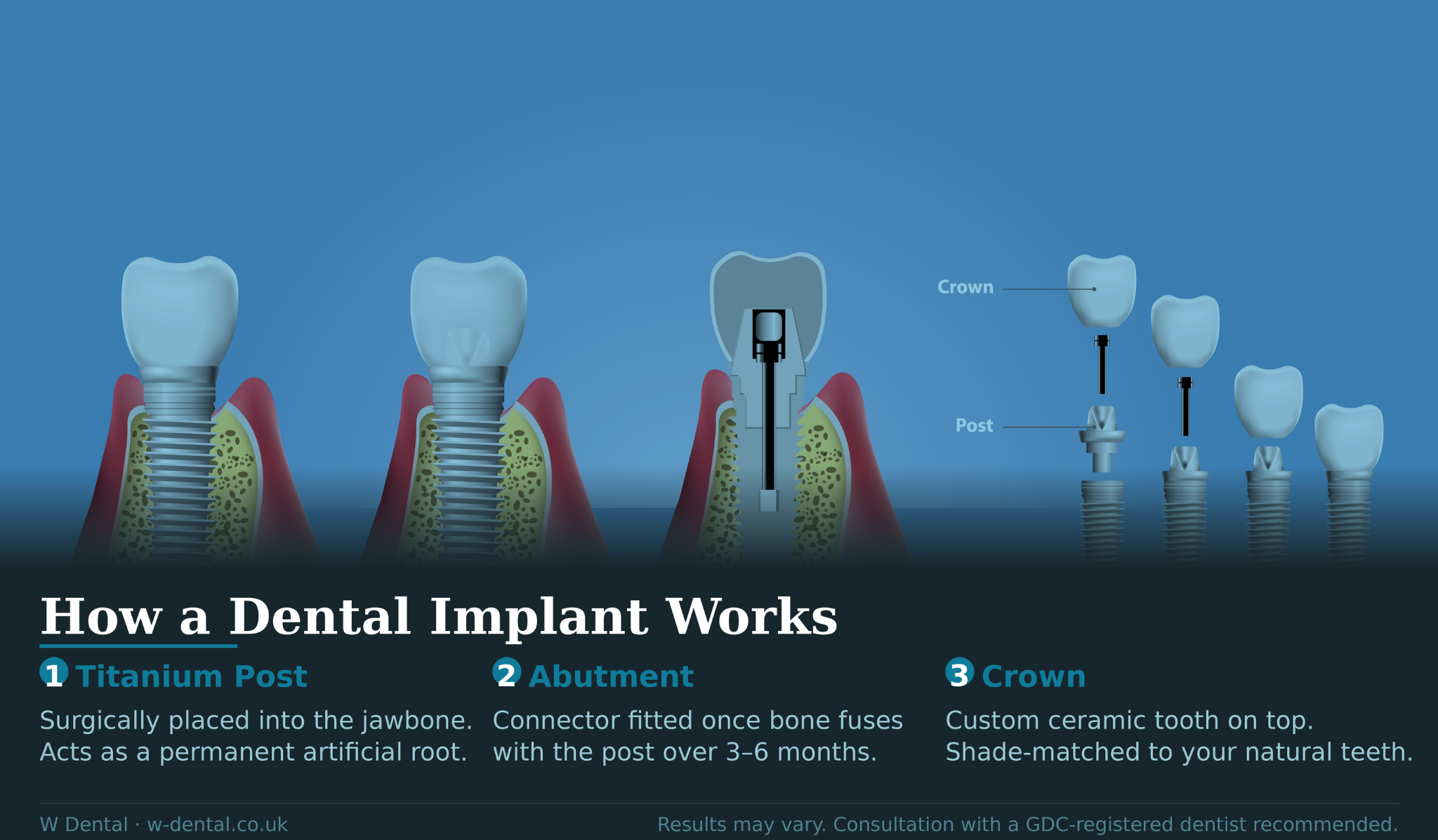
A dental implant is a small titanium post, surgically placed into the jawbone to act as an artificial tooth root. Once the post integrates with the surrounding bone, a connector piece (the abutment) is attached, and a custom ceramic crown is fitted on top. The finished result looks, feels, and functions like a natural tooth.
The process that makes implants so durable is called osseointegration. Over roughly three to six months, the jawbone grows around the titanium post, locking it firmly in place. This is what sets implants apart from every other tooth replacement: they become part of your jaw structure, rather than sitting on top of it.
Treatment happens in stages. Surgical placement comes first, followed by a healing period for osseointegration, then crown fitting. Some patients need preparatory work beforehand, such as bone grafting or extraction, which extends the overall timeline.
Are dental implants worth it? The honest cost breakdown
Cost is the number one reason patients hesitate, and rightly so. Implants are a private treatment in the UK; the NHS only funds them in very specific clinical circumstances, such as following jaw cancer surgery or certain congenital conditions. For the vast majority of patients, you are paying privately.
Here is what typical UK pricing looks like:
- Single implant (post, abutment, crown): £1,800–£4,000
- Multiple implants: Priced per implant; some practices offer reduced rates for multiple placements
- Full-mouth (All-on-4 or All-on-6): £12,000–£50,000+, depending on complexity and materials
These ranges vary by clinic location, implant brand, material quality, and the experience level of the dentist placing them. London and the South East tend to sit at the higher end. For a detailed, up-to-date breakdown of what affects pricing.
Additional costs to plan for:
The headline implant price rarely covers everything. Depending on your clinical situation, you may also need:
- Bone grafting: £500–£2,000 (required when jawbone has deteriorated)
- Sinus lift: £1,000–£2,500 (for upper back teeth where sinus sits close to the jaw)
- CT scan / 3D imaging: £100–£300
- Tooth extractions: Priced separately if the tooth is still present
At W-Dental, we provide a full written quote before any treatment begins. There are no surprises at the billing stage.
Payment plans:
The upfront cost should not be a barrier to treatment. W-Dental offers flexible payment plans, allowing patients to spread costs over time.
Ask about options during your consultation. Prices are subject to clinical assessment and may vary based on your individual treatment needs.
Are dental implants worth it? The case for long-term value
This is where the picture shifts. Implants feel expensive upfront. Spread across their working lifespan, they often cost less per year than repeated alternatives.
Longevity vs. the alternatives
With good oral hygiene and regular check-ups, implants routinely last 15–20 years. Some patients have had the same implants for 25 years or more. Dentures, by comparison, typically need replacing every 5–8 years. Bridges last 10–15 years but require the adjacent healthy teeth to be filed down to anchor the restoration, thereby permanently compromising those teeth.
Run the numbers on a single-tooth replacement over 20 years:
- Implant: £2,500 once = £125 per year
- Bridge (with two replacements): £1,500 x 2 = £3,000 = £150 per year, plus the long-term cost to the anchoring teeth
- Partial denture (with three replacements): £800 x 3 = £2,400 = £120 per year, with inferior function and ongoing maintenance costs
The gap closes considerably when you account for the full lifecycle, and implants deliver better function at every stage of it.
Bone preservation: The health benefit patients overlook
When a tooth is lost and not replaced, the jawbone beneath it begins to shrink. This process, called bone resorption, happens gradually but progressively. Dentures and bridges do not prevent this; they sit above the bone without stimulating it. Implants, because they are anchored into the jawbone like a natural root, preserve bone density by continuing to provide the mechanical stimulus the bone needs to maintain itself.
The British Dental Association recognises bone preservation as one of the primary clinical arguments for implants over alternative restorations. Left unaddressed, bone loss changes facial structure, causing the jaw to appear sunken and ageing the face faster than tooth loss alone would.
Quality of life: What patients actually notice
Patients who have had implants placed consistently report the same improvements: eating without restriction, speaking without self-consciousness, and smiling without worrying about movement or appearance. These are not trivial gains. For many patients, they represent a genuine restoration of confidence in professional and social settings.
Realistic recovery: What to expect week by week
Most competitor pages mention a “healing period” without explaining what it actually involves. Here is a straightforward timeline.
Weeks 1–2: surgical recovery
Expect swelling, bruising around the jaw, and mild to moderate discomfort. Your dentist will prescribe or recommend appropriate pain relief. You will be on a soft diet (think soup, mashed potatoes, scrambled eggs) and should avoid strenuous exercise for the first week. Oral hygiene is critical at this stage, but must be gentle around the surgical site.
Weeks 3–12: osseointegration
Swelling settles significantly by week three or four. The implant is quietly bonding with your jawbone during this period. Most patients return to normal activity by week four to six. You should avoid chewing hard foods directly on the implant site until the dentist confirms integration is stable.
Red flags to report promptly: persistent fever beyond day three, swelling that increases after day five, signs of discharge from the site, or any sensation that the implant is mobile.
Months 4–6: crown fitting
Once X-ray and clinical assessment confirm successful osseointegration, the permanent crown is fitted. This usually requires two to three appointments for precise fit and bite adjustment. Following crown placement, you can return to a normal diet gradually.
Are you a good candidate? Honest pre-screening criteria
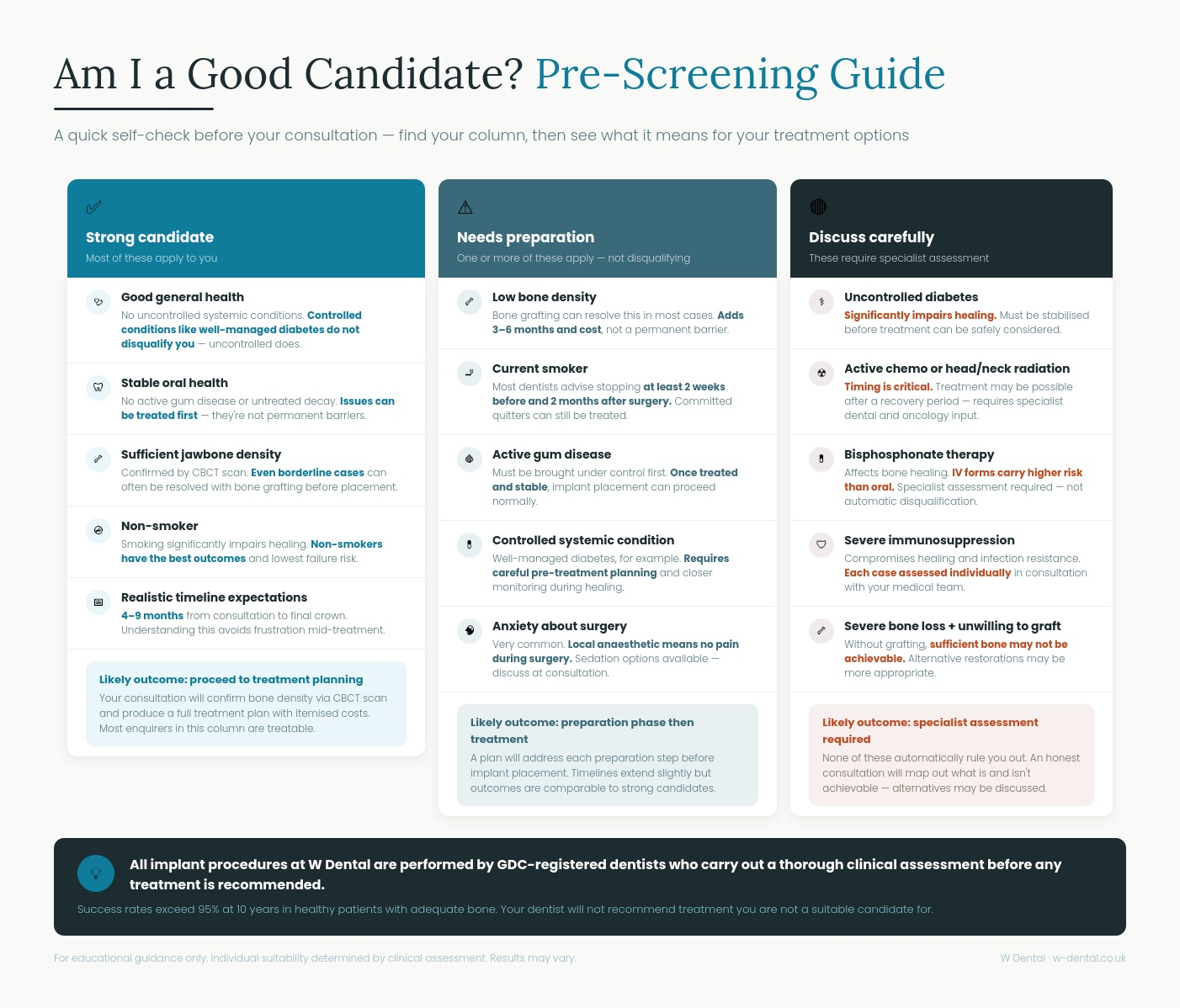
Not everyone is suited to implants, and a good dentist will tell you so rather than proceed regardless. At W-Dental, all implant procedures are performed by GDC-registered dentists who carry out a thorough clinical assessment before any treatment is recommended.
Factors that support candidacy
- Good general health, with no uncontrolled systemic conditions
- Stable oral health (no active gum disease or untreated decay)
- Sufficient jawbone density, or willingness to undergo bone grafting
- Non-smoker, or willingness to stop smoking during the healing phase
- Realistic expectations and a commitment to ongoing oral hygiene
Factors that may complicate or disqualify treatment
- Uncontrolled diabetes (affects healing significantly)
- Active chemotherapy or radiation therapy to the head and neck
- Heavy smoking (increases implant failure risk considerably)
- Bisphosphonate therapy (can affect bone healing)
- Severe immunosuppression
- Insufficient bone without a willingness to graft
This is not an exhaustive list. Your dentist will review your full medical and dental history before making any recommendations.
Implants vs. the alternatives: An honest comparison
Implants vs. dentures
Dentures are removable, lower in upfront cost (£300–£2,000 for a full denture), and accessible to most patients. They also require daily removal, soaking, and cleaning; can shift during eating and speaking; may require adhesive; and reduce taste sensitivity due to palate coverage. They do not prevent bone loss. Implants address all of these limitations, at a higher initial cost.
Implants vs. bridges
Bridges involve crowning the two teeth adjacent to the gap to anchor the replacement tooth. This means filing down healthy tooth structure permanently. Bridges last 10–15 years; implants last 15–20+. If you have healthy adjacent teeth, an implant preserves them entirely. This is one of the most clinically significant arguments for implants that patients rarely hear until it is too late.
Implants vs. doing nothing
Leaving a gap is not a neutral decision. Bone loss begins. Adjacent teeth drift. Opposing teeth over-erupt into the gap. Speech and eating are affected. Over years, the cumulative cost, functional loss, and health impact of an untreated gap often exceeds the cost of early implant treatment. Our team can discuss your specific situation and the likely trajectory if treatment is deferred.
Managing the risks: what you need to know
Implants have a strong safety record. Published clinical data in the UK, including evidence referenced by the Association of Dental Implantology (ADI), places long-term success rates above 95% in healthy patients with adequate bone. That figure reflects decades of refinement in implant design, surgical technique, and patient selection.
Risks do exist and should be understood clearly:
- Infection (peri-implantitis): The most common complication. Managed with antibiotics and, in severe cases, surgical intervention. Prevention is largely by good home care and regular check-ups.
- Implant failure: Rare. If integration does not occur, the implant is removed, and the site can usually be retreated after healing.
- Nerve involvement: Very rare with modern imaging-guided planning. Numbness or tingling in the lip or chin that persists beyond two weeks should be reported promptly.
- Sinus complications: Relevant only for upper back teeth. Addressed through careful surgical planning and, where necessary, a sinus lift procedure.
Smoking significantly increases failure risk. If you smoke, discuss this honestly with your dentist during the consultation.
Conclusion
So, are dental implants worth it? For most patients in good general health with adequate bone, the answer is yes. They last longer than any alternative, preserve jawbone health, function like natural teeth, and over a 20-year horizon often cost less per year than repeated denture or bridge replacements.
They are not right for everyone. Candidacy depends on your medical history, bone density, lifestyle factors, and expectations. That is precisely why an honest, thorough consultation matters before any decision is made.
If you are considering implants, the next step is a clinical assessment with our GDC-registered dental team at W-Dental. We will review your bone structure, oral health, and suitability, provide a full transparent quote, and give you our honest recommendation, whether that is implants, an alternative treatment, or a phased plan that works around your circumstances. For full details of our implant treatments, visit us or book your consultation directly. Results may vary. A consultation with your dentist is recommended before any treatment.
FAQs
Do dental implants hurt?
The surgical procedure is carried out under local anaesthetic, so you should feel pressure but not pain during placement. Post-operative discomfort is typically managed well with over-the-counter pain relief or prescribed medication and settles within a week for most patients.
How long do dental implants last?
With consistent oral hygiene and regular dental check-ups, most implants last 15–20 years. Some patients have functioning implants after 25 years. The crown on top may need replacing before the implant itself, typically after 10–15 years, depending on wear and bite forces.
Are dental implants worth it if I am a smoker?
Smoking substantially increases the risk of implant failure by impairing blood supply to the healing tissue and slowing osseointegration. Most dentists advise stopping smoking for at least two weeks before and two months after surgery. If you are committed to quitting, implants can still be an option. Your dentist will assess the risk with you.
How soon can I eat normally after implant surgery?
Soft foods only for the first two to four weeks post-surgery. By weeks four to six, most patients can reintroduce firmer foods cautiously. After crown fitting (months four to six), you can generally return to a normal diet, avoiding very hard or crunchy foods directly on the implant site in the early weeks.
What if something goes wrong after my implant is placed?
Contact your dental practice promptly. Signs of concern include fever, increasing swelling, discharge, or implant mobility. W-Dental’s emergency dentist service can assess post-surgical concerns without delay.
Can I get implants on the NHS?
In the UK, NHS funding for implants is extremely limited and restricted to very specific clinical circumstances, such as certain congenital abnormalities or following treatment for oral cancer. For the vast majority of patients, implants are a private treatment.