Full Mouth Dental Implants Cost in the UK (NHS & Private)
| TL;DR If you’re researching full mouth dental implants cost nhs, the short answer is that NHS funding is not available for routine cases. Private treatment typically costs £15,000–£20,000 per jaw, or £30,000–£40,000+ for both. Treatment takes 6–12 months from consultation to final restoration. It suits adults with adequate bone density, healthy gums, and a commitment to aftercare. Finance options can spread the cost over 3–60 months. |
If you’ve typed “full mouth dental implants cost nhs” into a search engine, you’re probably hoping the NHS can help cover the bill. The honest answer is: in most cases, it cannot. But before that discourages you, it’s worth understanding exactly what private treatment involves, what it realistically costs, and why it may be better value over a lifetime than the alternatives.
This guide covers NHS eligibility, realistic private price ranges, how the procedure works, what recovery looks like, and how to finance treatment. At W-Dental, our GDC-registered dentists take a straightforward approach: no vague pricing, no pressure, and no surprises.
Can you get full mouth dental implants on the NHS?
This is the question most patients come in asking, and the answer deserves a direct response.
NHS dental implants are available only in very specific clinical circumstances: severe facial trauma, head or neck cancer treatment, or rare congenital conditions where teeth never developed. Even then, treatment is delivered through NHS hospital dental departments rather than high street dental practices. A hospital consultant decides eligibility, not your regular dentist.
For the vast majority of patients, routine tooth loss due to decay, gum disease, or ageing does not meet the NHS clinical threshold. Full-mouth restoration is classified as a restorative or cosmetic treatment and falls outside NHS funding.
What the NHS does offer as alternatives:
- Dentures (removable, covered under Band 3 at £332.10, as of March 2025 per NHS.uk)
- Bridges (also Band 3, but require grinding down adjacent healthy teeth)
Neither option preserves the jawbone or replicates the feel of natural teeth the way implants do. If you’ve been told NHS implants aren’t available for your situation, private treatment is the realistic path, and it doesn’t have to cost as much as you might fear.
NHS eligibility:
NHS implants apply only to trauma, cancer, or congenital tooth absence cases, assessed by a hospital consultant. Routine tooth loss, however extensive, does not qualify.
What does the NHS cover?
Band 3 NHS treatment (£332.10) covers dentures and bridges. These are functional alternatives but come with limitations around stability, bone preservation, and long-term durability.
NHS Band 3 covers dentures and bridges from £332.10; private full-arch implants range from £15,000 to £40,000+, depending on complexity.
What does full mouth dental implants cost in the UK?
Private full mouth implants in the UK typically fall within these ranges:
| Treatment | Typical UK Cost |
| Single arch (upper or lower jaw) | £15,000–£20,000 |
| Both arches (full mouth) | £30,000–£40,000+ |
| All-on-4 (per arch, immediate loading) | £14,000–£22,000 |
| All-on-6 (per arch, more implants) | £18,000–£28,000 |
These figures reflect market rates reported by established UK practices. Your specific quote may sit outside this range depending on the factors below.
Prices are subject to consultation and may vary based on individual clinical needs.
Key cost drivers
Five factors move the final price more than anything else:
- Number of implants. Full arch solutions typically use four to eight implants per jaw. More implants mean greater stability but higher cost.
- Implant materials. Titanium implants are the clinical standard. Zirconia (ceramic) implants are metal-free and suit patients with sensitivities, but cost more.
- Prosthetic choice. Acrylic bridges cost less than hybrid composites or full-zirconia arches. Zirconia is more durable and more lifelike, but carries a premium.
- Additional surgeries. Bone grafting (if bone density is insufficient) or a sinus lift (for upper jaw cases with limited bone height) adds cost and time, often £500–£3,000 per site.
- Practice location and clinician expertise. Central London practices typically charge more than regional ones; specialist implantologists command higher fees than general dentists.
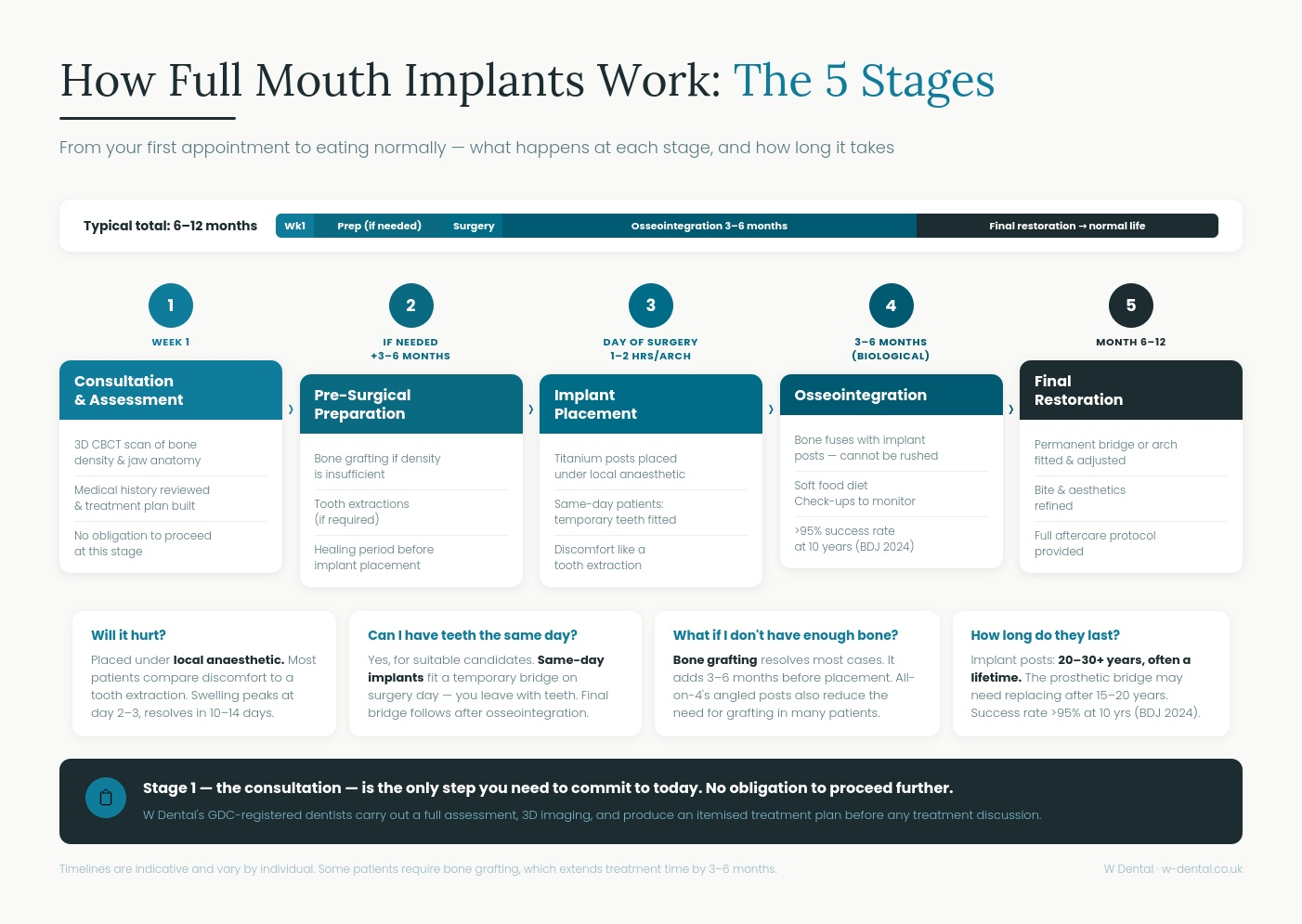
How full mouth dental implants work: step-by-step
Understanding the procedure helps set realistic expectations. Here’s how treatment typically progresses.
Stage 1: Consultation and assessment
Your dentist carries out a full clinical examination, takes 3D CBCT imaging to assess bone density and jaw anatomy, reviews your medical history, and produces an individual treatment plan. This stage also identifies whether you’re a suitable candidate. If implants aren’t the right option for you, an honest alternative will be discussed. W-Dental’s GDC-registered dentists won’t recommend treatment you don’t need.
Stage 2: Pre-surgical preparation (if needed)
If bone density is insufficient, bone grafting is carried out first, followed by a healing period of three to six months before implant placement can proceed. Tooth extractions, if required, may also happen at this stage.
Stage 3: Implant placement
Under local anaesthesia, titanium implant posts are placed into the jawbone through small incisions. The procedure typically takes one to two hours per arch. Discomfort is broadly comparable to a tooth extraction. Swelling and bruising peak at 48–72 hours and generally resolve within 10–14 days.
For patients who are suitable candidates, same day dental implants allow a temporary prosthesis to be fitted on the same day as surgery, so you leave the practice with teeth.
Stage 4: Osseointegration (three to six months)
The implants integrate with the jawbone over three to six months. This is not optional, it is biological. During this period, you’ll have check-up appointments to monitor healing. Diet is restricted to soft foods for the first few months.
Stage 5: Final restoration
Once osseointegration is confirmed, the final bridge or arch is attached and adjusted for bite and aesthetics. You’ll receive a detailed aftercare protocol at this stage.
From consultation to final restoration, full mouth implant treatment typically spans six to twelve months, with osseointegration taking the longest portion.
Full mouth implants vs other restoration options
It’s worth comparing implants honestly against the alternatives before committing.
| Factor | Full mouth implants | Dentures | Fixed bridge |
| Bone preservation | Yes, stimulates bone | No, bone resorption continues | Partial |
| Stability | Fixed, like natural teeth | Removable, can slip | Fixed but limited |
| Adjacent teeth affected | No | No | Yes, requires grinding |
| Lifespan | 20–30+ years with care | 5–8 years before replacement | 10–15 years |
| Long-term cost | Higher upfront, lower ongoing | Lower upfront, recurring costs | Moderate |
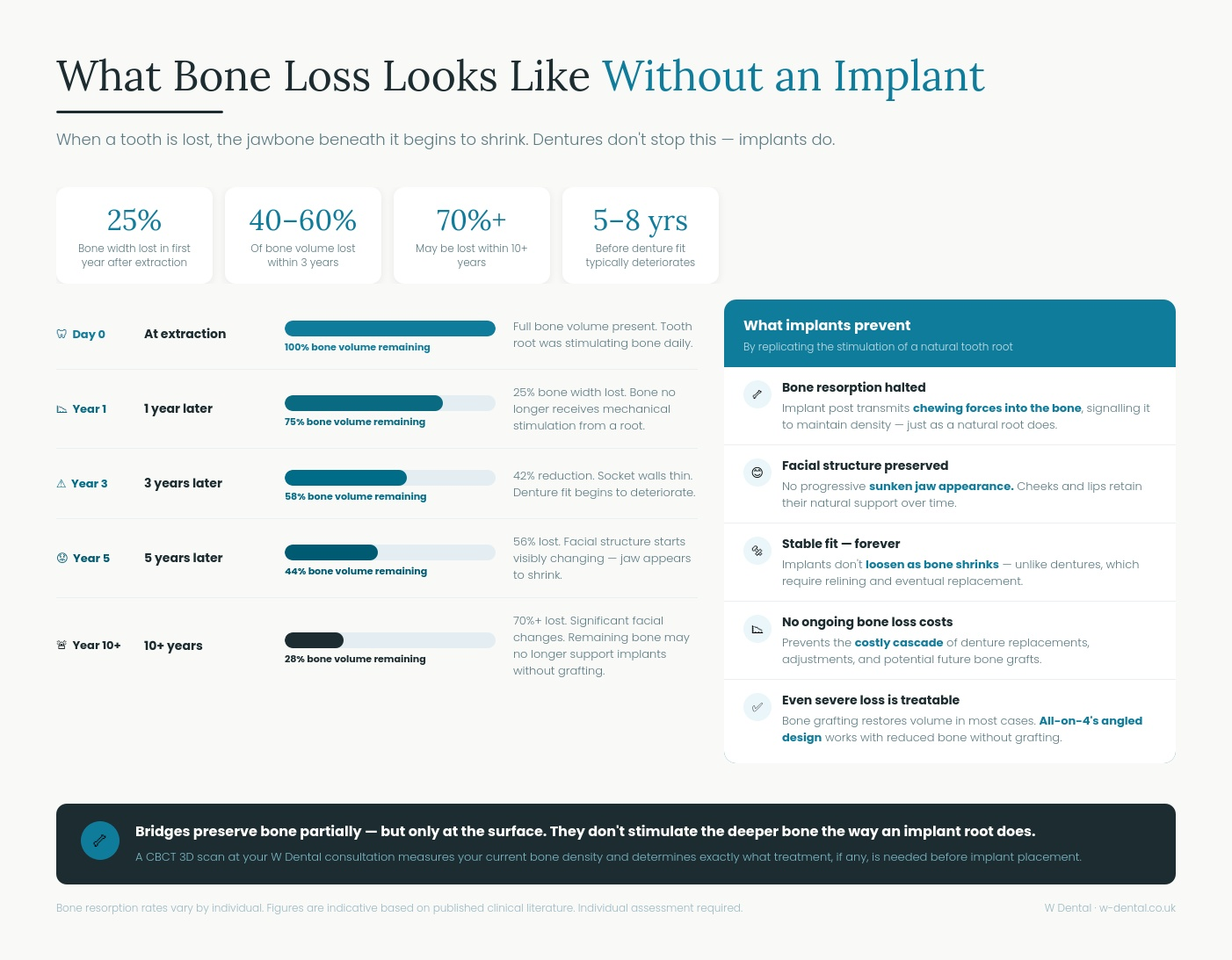
Why bone preservation matters
When teeth are lost, the jawbone underneath begins to shrink because it’s no longer being stimulated. Dentures do not address this. Over 10–15 years, significant bone loss leads to changes in facial structure, including a sunken appearance around the jaw and mouth. Implants replicate the stimulation of natural tooth roots, slowing or stopping this process.
The real cost of dentures over time
Dentures appear cheaper upfront, roughly £332.10 on the NHS or £1,000–£3,000 privately. But they require replacement every five to eight years, ongoing adjustment appointments, and adhesive products. When you factor in 20 years of replacement cycles and appointments, the cost gap narrows considerably. The quality-of-life difference is harder to quantify but consistently reported as significant by patients who have switched from dentures to implants.
Recovery and aftercare: what to realistically expect
No competitor page gives a realistic week-by-week breakdown. Here’s ours.
Week 1: Rest, soft food only (soup, yoghurt, mashed meals), avoid alcohol and smoking. Pain is managed with over-the-counter ibuprofen or paracetamol. Swelling peaks around day two or three.
Weeks 2–4: Swelling and bruising resolve. Gradually reintroduce soft foods. Light activity resumes but avoid anything that raises blood pressure significantly (heavy exercise, contact sports).
Months 2–3: Most patients feel close to normal. Continue avoiding hard or crunchy foods. Attend your scheduled check-up.
Months 4–6: Osseointegration completes. Final restoration is fitted. Normal diet resumes.
Long-term, implants require the same daily care as natural teeth: twice-daily brushing, flossing or interdental brushes, and an annual professional clean. Smoking significantly increases the risk of implant failure and peri-implantitis (infection around the implant), so stopping before treatment is strongly advisable.
Are full mouth implants right for you?
Implants are not suitable for everyone, and any practice that tells you otherwise without a proper assessment isn’t being straight with you.
Good candidate indicators:
- Adequate bone density (or willingness to undergo grafting)
- Healthy gums or active gum disease, brought under control before treatment
- Non-smoker, or committed to stopping before and during healing
- Stable general health, including managed diabetes if applicable
- Realistic expectations about timeline, cost, and recovery
Factors that need discussion:
- Severe bone loss (grafting often resolves this, but adds time and cost)
- Active smoking (increases failure risk considerably)
- Bisphosphonate therapy (requires specialist assessment)
- Uncontrolled systemic conditions
None of these automatically rules you out. They just require careful planning. A thorough consultation with a GDC-registered dentist gives you the full picture.
To explore your options and understand exactly what our dental implants service involves, book a consultation with the W-Dental team.
Conclusion
Full mouth dental implants cost in the UK reflects the complexity and longevity of the treatment. NHS funding is not available for routine cases, but private treatment, with realistic costs between £30,000–£40,000 for both jaws, offers something dentures and bridges cannot: a fixed, bone-preserving, long-term solution that functions like natural teeth.
Recovery is manageable, success rates are strong, and finance options make treatment accessible for more patients than you might expect. If you’ve been putting off a decision because of uncertainty about cost, NHS eligibility, or what the procedure involves, a consultation is the clearest next step. W-Dental’s GDC-registered team provides honest assessments, itemised quotes, and no-pressure guidance from initial appointment through to long-term aftercare.
Results may vary. A consultation with your dentist is recommended before any treatment. This article is for general information only and does not constitute personal dental advice. Individual costs, timelines, and suitability vary. Prices correct at time of publication and subject to change following consultation.
FAQs
Will the surgery hurt?
The procedure is carried out under local anaesthesia. Most patients report discomfort comparable to a tooth extraction. Swelling and bruising are normal and peak at 48–72 hours, resolving within one to two weeks. Standard over-the-counter pain relief manages the post-operative period for most patients.
Can I really not get full mouth dental implants on the NHS?
Correct, in almost all cases. NHS implants are restricted to patients with severe trauma, head or neck cancer, or rare congenital conditions, and are only delivered through NHS hospital settings. Routine tooth loss, including extensive decay or gum disease, does not meet the NHS clinical threshold.
How long do implants last?
With good oral hygiene and regular professional check-ups, implants can last 20–30 years or a lifetime. Systematic review data published in the British Dental Journal (2024) places long-term success rates above 95% at ten years. The prosthetic bridge on top may need replacement after 15–20 years, depending on wear.
How much does a full set of dental implants realistically cost?
For one arch (upper or lower jaw), expect £15,000–£20,000. For both jaws, budget £30,000–£40,000 or more. Bone grafting, implant material choice, and practice location all affect the final figure. Prices are subject to individual consultation. Finance options are available to spread costs.
What is the difference between All-on-4 and traditional full-arch implants?
All-on-4 uses four strategically angled implants per arch to support a full bridge, often allowing same-day loading. Traditional full arch uses six to eight implants, which may offer greater long-term stability in certain jaw structures. Your dentist will recommend the appropriate approach based on your bone density and anatomy.
How do I book a consultation at W-Dental?
You can book directly through the W-Dental website. A consultation includes full clinical examination, 3D imaging where appropriate, and a detailed treatment plan with itemised costs. No obligation to proceed at that stage.