


Most people looking for a smile makeover already know what bothers them. What they usually don’t know is what treatment fixes it, in what order and how many natural teeth they are expected to give up along the way.
This guide explains what a smile makeover actually involves, what treatments make it up, why the sequence matters, what the research says about the results and how much it costs.
What is a Smile Makeover?
A smile makeover is a coordinated treatment plan, rather than a product. Two people can both have a smile makeover and undergo completely different procedures.
The starting point is a conversation about what specifically bothers you, followed by an assessment of whether your teeth and gums are healthy enough to build on them. Only then does the question of which treatments to use come into it.
The plan might involve one visit or several months. It can cost a few hundred pounds or several thousand. What makes it a makeover is that the treatments are planned together.
What Can Be Included in a Smile Makeover
These are the treatments most commonly combined.
Hygiene and gum treatment
Composite bonding, veneers, and whitening work poorly on inflamed gums, and no cosmetic result is sustained if the foundation is not healthy.
Teeth whitening
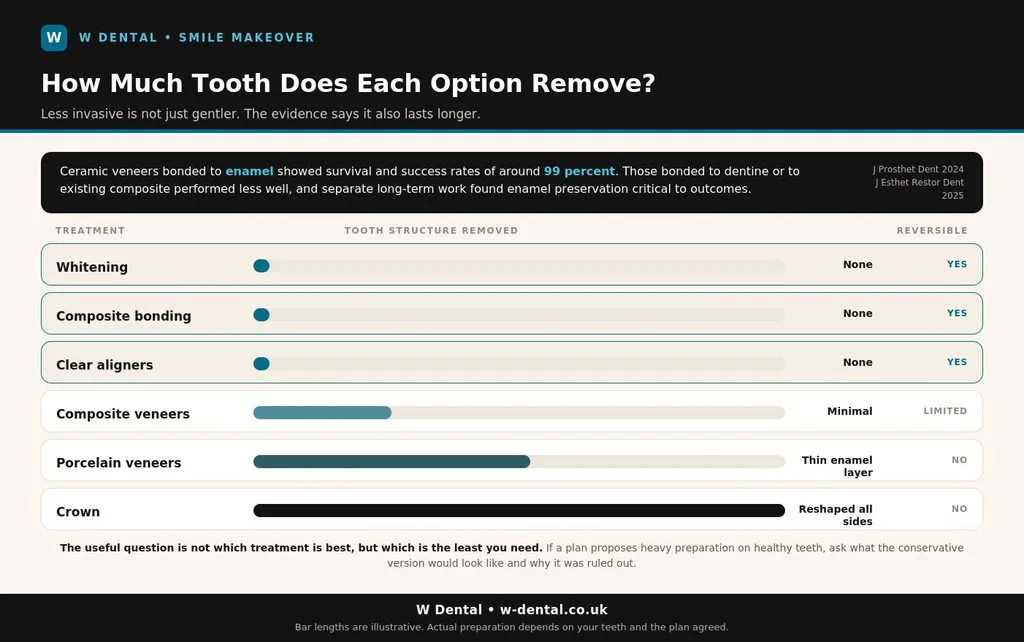
It is usually the cheapest way to achieve visible change. Whitening lightens natural enamel, but has no effect on existing crowns, veneers or fillings, and that is why it is done before any restoration work.
Composite bonding
Tooth-colored resin applied directly to reshape, close small spaces or repair chips. Composite bonding involves no drilling, is done in a single visit and is reversible in a way veneers are not.
Veneers
Thin shells bonded to the front of the tooth. Composite veneers are more affordable; porcelain veneers are more stain-resistant and long-lasting. Both involve some preparation; porcelain usually more.
Clear Aligners
Where teeth are crowded, gapped or rotated, moving them is usually better than covering them. Aligners first frequently reduce how much restorative work is needed.
Crowns
Where a tooth is structurally compromised, a crown protects and improves it at the same time.
The Order Matters More Than Treatments
This is where a good plan separates from a treatment liist.
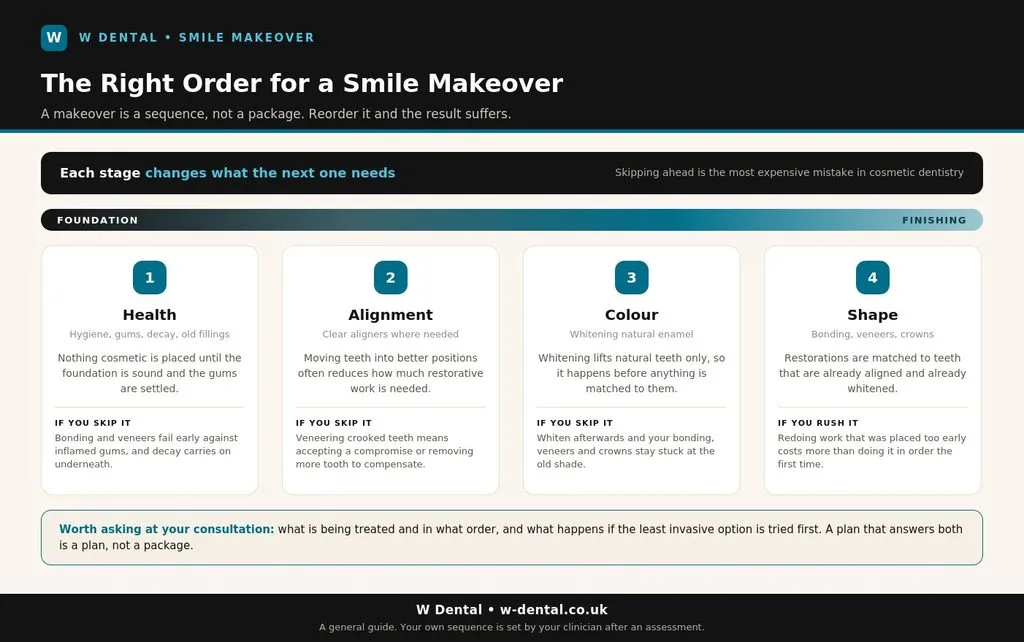
1. Health:
Decay, gum disease and falling restorations are treated before starting anything cosmetic.
2. Alignment:
Moving your teeth into a better position often reduces the amount of composite bonding or veneers needed, and sometimes eliminates it.
3. Colour:
Whitening is done before restorations, because resin or ceramics are matched to your teeth that same day and will not lighten later.
4. Shape:
Composite bonding, veneers and crowns are matched to the newly aligned, whitened teeth.
Whitening after bonding, and the bonded teeth stay the old shade. If you put veneers on crooked teeth without aligning them first, either you get a compromised result or remove more tooth structure to compensate.
What the Research Says
A systematic review on ceramic veneers found that ceramic veneers bonded to enamel had survival and success rates of around 99%, while those bonded to dentine or previous composite showed lower figures.
Another analysis on ceramic veneers came to the same conclusion, reporting that the extent of dentine exposure significantly affects survival, and enamel conservation is critical to optimising results.
The practical implication is simple. A plan that removes less tooth is not only more conservative, but tends to last longer. If a clinic proposes aggressive preparation on healthy teeth, it is fair to ask what the more conservative option would be and why it has been ruled out.
In psychological terms, a review of studies on aesthetic dental treatment found a consistent positive impact on self-esteem and quality of life following treatment. A cross-sectional study on psychological impact in patients seeking dental aesthetic treatment using validated psychosocial measures reported a significant correlation between dental aesthetics and psychosocial status, noting that restorative and prosthetic treatments influence social self-esteem as well as oral health.
The Process at W Dental for Smile Makeover
1. Consultation and 3D preview:
Teeth, gums and bite are assessed, and a digital scan generates a preview of the expected result. This appointment is free.
2. Planning:
The treatments are sequenced, the costs are set out, and the schedule is agreed before starting anything.
3. Preparatory work:
Any decay, gum disease or failing restorations are addressed first.
4. Phases of treatment:
Aligners, whitening and restorative work in the order required by the plan.
5. Review and maintenance:
Retainers if aligners were used, hygiene appointments and periodic checks of any composite bonding or veneers.
If dental anxiety is part of what has held you back, W Dental’s guide to navigating an appointment as a nervous patient is worth reading first.
What Does a Smile Makeover Cost?
At W Dental, the prices for each treatment are based on the following figures:
- Smile makeover consultation with 3D preview: Free
- Hygiene with airflow: £150
- Composite bonding: from £150 per tooth
- SmileWhite whitening: from £395
- Composite veneers: from £450 per tooth
- Enlighten whitening: from £695
- In-surgery whitening: from £695
- eMax crown: from £850
- Porcelain veneers: from £895 per tooth
- 32Co aligners: from £1,500
- Invisalign®: from £2,800
0% finance is available in treatment plans above £500. A makeover that combines whitening and composite bonding on visible teeth is placed in a very different price range than that of one that includes aligners and porcelain veneers, and that is why consultation matters before any figure is quoted.
Conclusion
A smile makeover is worth having when planned as a sequence and not sold as a closed package. The questions that separate a good plan from an expensive one are simple: what will be treated and in what order, how much natural tooth will be removed, what would happen if the least invasive option was tried first, and what maintenance will be needed later. A consultation that answers all is the right place to start.
(General information only. The suitability of the treatment, the expected results and the prices can only be confirmed by a professional after a clinical examination.)
FAQs
How long does a smile makeover take?
Anything from a single visit for bonding and whitening to twelve months or more where aligners are involved.
Does a smile makeover look fake?
Not if it’s well planned. The shade, shape, and proportions are chosen relative to your face, and the test phase exists so you can approve the result first.
Is a smile makeover painful?
Most components do not hurt. Composite bonding and whitening do not require drilling the teeth. The veneers and crowns are done under local anaesthesia.
Can I just have one part of a smile makeover?
Yeah. Many people start by whitening or composite bonding and decide later whether to go further.
Does a smile makeover require maintenance?
Yes, teeth whitening fades, composite bonding stains and veneers and crowns eventually need replacement. Retainers are essential if aligners have been used.
 Recent Blogs
 Book Your Visit