


When several teeth are missing in a row, the decision is rarely between an implant and nothing. It is usually between a conventional bridge, which leans on the teeth on either side, and an implant bridge, which supports itself.
The difference matters more than it seems, because one option requires drilling down healthy teeth and the other does not. This guide explains how an implant-supported bridge works, what the types are, how long it lasts according to the available evidence, what complications are really common and how much it costs.
What is an Implant Bridge?
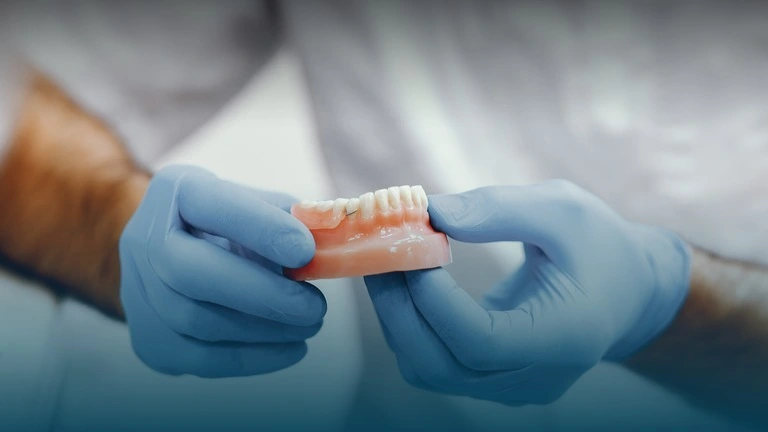
A bridge over implants is a fixed prosthesis that replaces two or more adjacent teeth. Instead of resting on natural teeth, it is screwed or cemented onto titanium implants integrated into the jawbone.
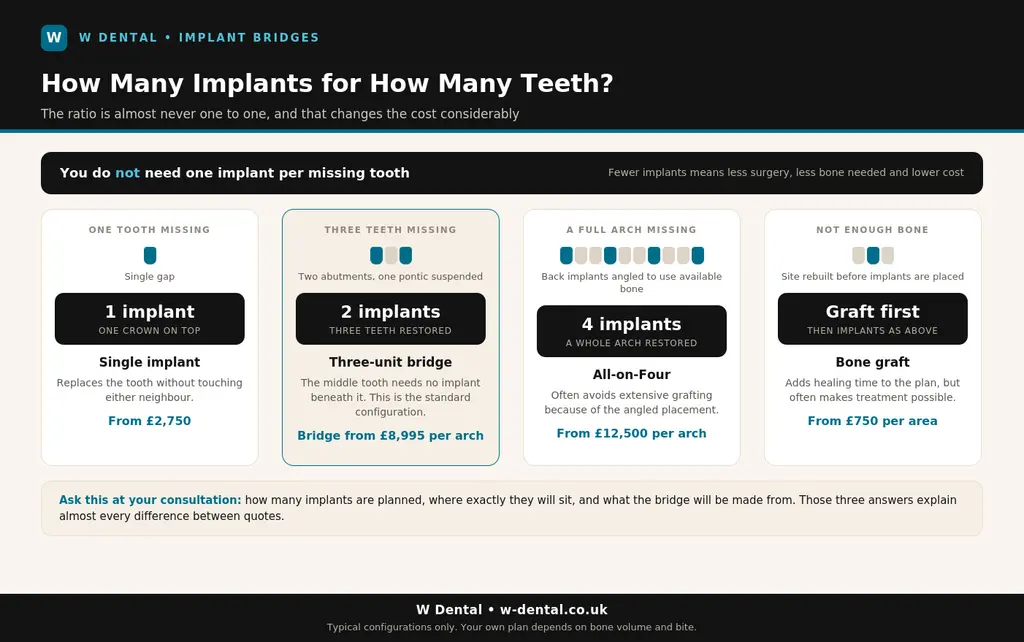
The key is in the ratio: you don’t need an implant for each lost tooth. Three missing teeth can be replaced with two implants and a three-unit bridge, where the middle tooth, called a pontic, is suspended between the two pillars.
This reduces the number of surgeries, the cost and the amount of bone needed, maintaining a fixed restoration that is not removed to clean.
Types of Implants Bridges
The configuration depends on how many teeth are missing and where they are.
Three-unit Bridge
The most common choice. Two implants hold three teeth. It is the standard solution when three consecutive teeth are missing.
Full Arch Bridge
An entire arch supported on four, six or eight implants. This is where all-on-four protocols sit, where the back implants are placed angled to make use of the available bone and avoid grafting.
Cantilever Bridge
The bridge carries one tooth in an unsupported extension, with no implant underneath. It is used when the posterior bone does not allow another implant to be placed, and requires particularly careful bite control.
Hybrid bridge
It combines a metal framework with acrylic or ceramic teeth and an artificial gum. It is used when, in addition to teeth, volume of gum and bone has been lost.
Implant Bridge vs Conventional Bridge
| Factors | Implant Bridge | Conventional Bridge |
| Supported by | Own implants | Neighbouring teeth, drilled down |
| Healthy teeth suffered | None | Two or more |
| Preserves bone | Yes, at the implant site | No |
| Treatment length | Months | Weeks |
| Cost from | £8,995 per arch | £895 per tooth |
No choice is better in the abstract. The conventional bridge is faster and cheaper, but it involves cutting down teeth that could be completely healthy. An implant bridge preserves those teeth and maintains bone at the implant sites, in exchange for more time and more cost.
For a closer look at how implants and bridges compare, W Dental covers the differences in treatment time, cost, longevity and long-term impact.
Step-by-step Process of Implant Bridge
The treatment is spread over several months, and most of that time is healing, not appointments.
1. Assessment and planning:
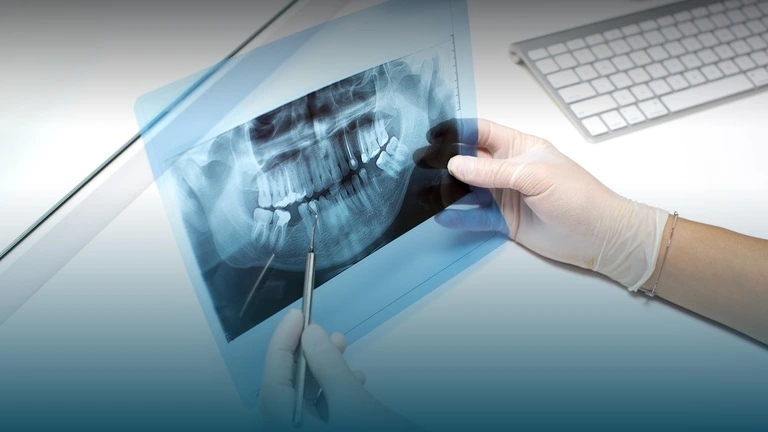
Clinical scan, digital scanner, and X-rays to measure available bone and locate nerves and sinuses.
2. Preparation if necessary:
Extractions or bone grafting first, with their own healing period.
3. Implant placement:
Inserted under local anaesthesia. A temporary restoration is usually worn during integration.
4. Osseointegration:
The bone fuses to the surface of the implant over about three to six months.
5. Records taken:
The abutment is fitted, and the exact position is scanned to make the final bridge.
6. Bridge location:
The finished bridge is secured, and the bite is adjusted.
What the Research Says
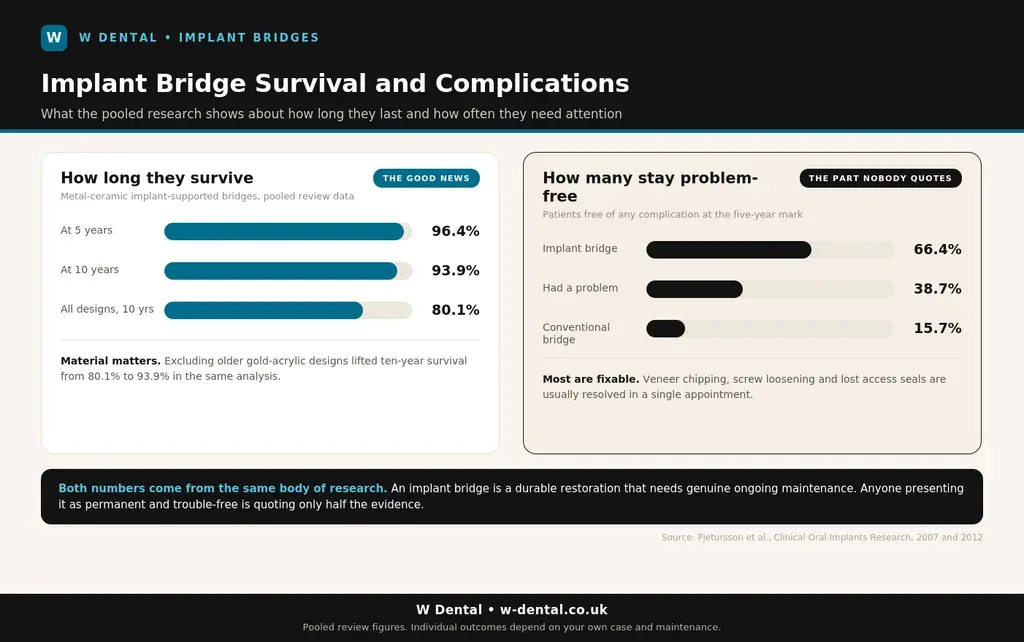
A systematic review of survival rates for implant-supported dental prostheses reported 95.4% survival at five years and 80.1% at ten years. When analysing only metal-ceramic bridges, excluding older gold-acrylic bridges, the figures rose to 96.4% and 93.9% respectively.
Regarding complications, the same review found that only 66.4% of patients were free of any complications at age five. The most common were fracture of the ceramic coating (13.5%), peri-implantitis and soft tissue complications (8.5%), loss of access hole restoration (5.4%) and abutment or screw loosening (5.3%).
Maintenance and Daily Care of an Implant Bridge
The bridge itself cannot decay, but the surrounding tissue can become inflamed, and that is the critical point.
- Cleaning beneath the bridge
Clean under the bridge daily with interdental brushes, superfloss or a water flosser.
- Follow-up hygiene appointments
Keep up hygiene appointments and reviews at the interval you are given.
- Report changes early
Report any movement, clicking or sensation of a loose screw without waiting.
- Protect against grinding
Wear a night guard if you clench or grind, because overload fractures ceramics.
- Avoid excessive pressure
Avoid biting hard objects and opening containers with teeth
Prices of Implant Bridges in London
At W Dental, prices start as follows:
- Bridge over implants, by arch: from £8,995
- Unit implant with crown included: from £2,750
- Conventional bridge, per tooth: from £895
- All-on-four implants, by arch: from £12,500
- Bone graft, by area: from £750
- First consultation with scan, X-rays and plan: £65
Funding is available at 0%. The final price depends on the number of implants, whether grafting is needed and the bridge material.
Conclusion
An implant bridge solves the loss of several teeth without damaging healthy ones, and the evidence supports their survival in the medium and long term. It also shows that technical complications are a normal part of your life, not a sign that something went wrong. The questions to ask before deciding are how many implants are to be placed, what material the bridge will be made of, and how often it will have to be reviewed.
(General dental information only. The suitability of treatment, results and prices can only be confirmed by a professional after a clinical examination)
FAQs
How many implants do I need?
It depends on the number of missing teeth and the quality of the bone, but it hardly ever takes one per tooth.
Does the procedure for an implant bridge hurt?
Placement is performed with local anaesthesia. It is normal to notice discomfort for a few days; afterwards, it is normal and manageable with usual painkillers.
Can you remove the bridge?
Not day-to-day. It is a fixed prosthesis, although the professional can remove it if it is screwed and needs maintenance.
What if a screw loosens?
It is one of the most frequent complications and usually resolves at an appointment. It should not be delayed, because a loose screw can fracture.
How long will I be without teeth?
Usually none. A temporary prosthesis is usually worn during the integration phase.
Does it work if I’ve been without those teeth for years?
Often yes, although bone reabsorption may require a graft first.
 Recent Blogs
 Book Your Visit