


Losing teeth changes much more than smiling. It affects what can be eaten, how the voice sounds and, in time, the shape of the face itself, because the bone that held the roots begins to reabsorb.
Removable prostheses remain the most accessible solution to replace several parts at once, but it is important to know what to expect before deciding. This guide explains the types available, the whole process, what the scientific evidence says about their care and how much they cost.
What Exactly are Dentures?
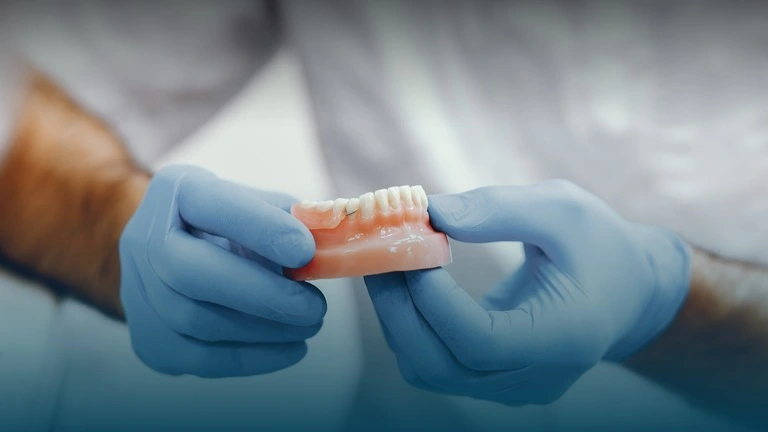
A denture is a removable device that replaces lost teeth and the tissue of the gums around them. It rests on gum and alveolar bone, and in some cases on the remaining natural teeth or on implants.
Unlike a dental implant, which replaces the root of the tooth, the removable prosthesis rests on the edge. That is the key difference: it does not slow bone resorption, although it does restore function and appearance.
Types of Dentures
Not all prostheses are the same, and the choice depends on how many teeth are missing and the state of bone and gums.
Full Dentures
They replace all the teeth of an arch. They are held in place by suction against the palate in the upper jaw, which helps the upper sole stabilise better than the lower.
Partial Dentures
They replace some parts when there are still natural teeth. They can be acrylic or chrome-cobalt; the latter is thinner, more resistant, and has better thermal transmission, although it is more expensive.
Immediate Dentures
They are placed on the same day as extractions so as not to spend time without teeth. As the gum heals and changes shape during the following months, they almost always need a rebase or a later replacement.
Overdentures on Implants
The prosthesis is anchored to two or more implants using a clip system. It’s still removable to clean it, but it doesn’t move when eating or talking.
| Factors | Complete | Partial | Implant-supported |
| Replaces | Entire arch | Some teeth | Entire arch |
| Retention | Suction and fit | Clasps or attachments | Clips onto implants |
| Stability when eating | Variable, especially lower | Good | Very good |
| Prevents bone loss | No | No | Partially |
| Price from | £1,500 | £1,500 | £7,500 per arch |
Step-by-step Denture Process
The process is usually divided into several appointments over a few weeks.
Initial valuation. Remaining gums, bone, and teeth are examined, and it is decided if previous extractions are needed.
Impressions or scan:
The exact measurements of the mouth are recorded.
Bite log:
The relationship between the two arcades and the correct height is determined.
Try wax:
The shape, colour and position of the teeth are checked before making the final prosthesis.
Placement:
The finished prosthesis is delivered, and the pressure points are adjusted.
Adjustment revisions:
The first few weeks usually require small tweaks.
What To Really Expect After Dentures
It should be realistic: the first weeks are learning, not immediate comfort. It is normal to notice the bulky prosthesis, to salivate more than usual and for painful areas to appear. Those pressure points are corrected at adjustment appointments, so you don’t have to put up with them or try to file them at home.
To eat, start with soft foods cut into small pieces and chew with both sides at once to share the load. To speak, reading aloud for a few minutes a day greatly accelerates the adaptation to words that at first sound strange.
Most people feel comfortable after about four to eight weeks, although it varies depending on the case.
Daily Cleaning and Care of Dentures
Prosthetics accumulate plaque and fungi just like natural teeth, and there is a problem that is most underestimated.
- Remove and rinse the prosthesis after each meal
- Brush it daily with a specific brush and mild soap or prosthetic cleaner, never with toothpaste, which is abrasive and creates micro-rays where the plate is housed
- Immerse it in a cleansing solution according to product instructions
- Clean your gums, tongue and palate with a soft brush before putting it back in
- Never use hot or boiling water, because it deforms the acrylic permanently
- Manipulate on a towel or washbasin with water, as falling on a hard surface often fractures it
- Save it in water or in the solution indicated when you do not wear it
What the Research Says
Prosthetic stomatitis is an inflammation of the mucosa that remains under the prosthesis, usually associated with Candida. A systematic review of denture stomatitis reports a global prevalence of 20%-67% among removable prosthesis carriers and identifies continued unremoved use, poor hygiene, and poorly adjusted prosthetics as risk factors.
In a prospective study on sleeping with the prosthesis, researchers followed people aged 85 and older and found that those who wore it during sleep had a 2.3-fold higher risk of pneumonia than those who removed it at night. It is an association observed in a very large population, not a causal relationship demonstrated in all ages, but it reinforces the usual recommendation to remove it when sleeping.
Costs of Dentures
At W Dental, prices are based on the following figures:
- Dentures, acrylic or chrome, as the case may be: from £1,500
- Overdents on implants, by arcade: from £7,500
- Simple extraction, if necessary beforehand: from £250
- First consultation with scan, X-rays and personalised plan: £65
Funding is available at 0%. The final price depends on the material, the number of teeth to be replaced and whether prior treatment is required. You can see the full list of rates for the rest of the treatments.
Conclusion
Dentures remain a valid and accessible solution to replace multiple teeth, provided you understand what they can and cannot do. They return function and aesthetics, but do not stop bone loss, and require periodic reviews and rigorous cleaning. If stability is your main concern, it is worth asking about implant options before deciding.
(General information of a disclosure nature. The suitability of treatment, results and prices can only be confirmed by a professional after a clinical examination.)
FAQs
How long do dentures last?
They usually need to be over-based or replaced every certain number of years, because the bone changes shape over time and the prosthesis stops adjusting.
Can you sleep with dentures on?
It is advisable to remove dentures at night so that the mucosa rests and for the reasons of hygiene described above.
Are adhesives necessary with dentures?
A well-fitting prosthesis should not depend on adhesive. If you need it every day, you’ll probably need a rebasement or adjustment review.
Do dentures change the way you talk?
At first, yes, especially with certain consonants. It usually resolves in a few weeks with practice.
Can I eat everything with dentures?
In time, almost everything. Foods that are very hard, very sticky or with small seeds remain the most problematic.
What do I do if a denture breaks?
Go to the clinic. Do not try to repair dentures with domestic glues, because they are toxic and often prevent further professional repair.
 Recent Blogs
 Book Your Visit