


If you’ve been told you need a bone graft before an implant, it simply means there isn’t enough bone to support the implant yet. A graft helps rebuild the area so the implant has a strong foundation to heal and stay securely in place.
This guide explains why bone is lost, what types of grafts exist, how they differ, what procedures are available, what the latest research on materials says, and how much it costs.
What is a Dental Bone Graft?
A dental bone graft is a procedure in which material is placed in an area of the jaw where bone is missing, so that the body grows new bone around and inside that material.
It is not a case of fixing a block in a place and calling it done. The graft acts as a scaffolding: it holds the space, guides the patient’s own bone cells and, over time, is partly or totally replaced by living bone. This process takes months, and is why the graft almost always precedes the dental implant rather than accompanying it.
Why Do You Lose Bone?
Alveolar bone exists to hold the roots of teeth. When a tooth is lost, that bone stops being stimulated and is reabsorbed.
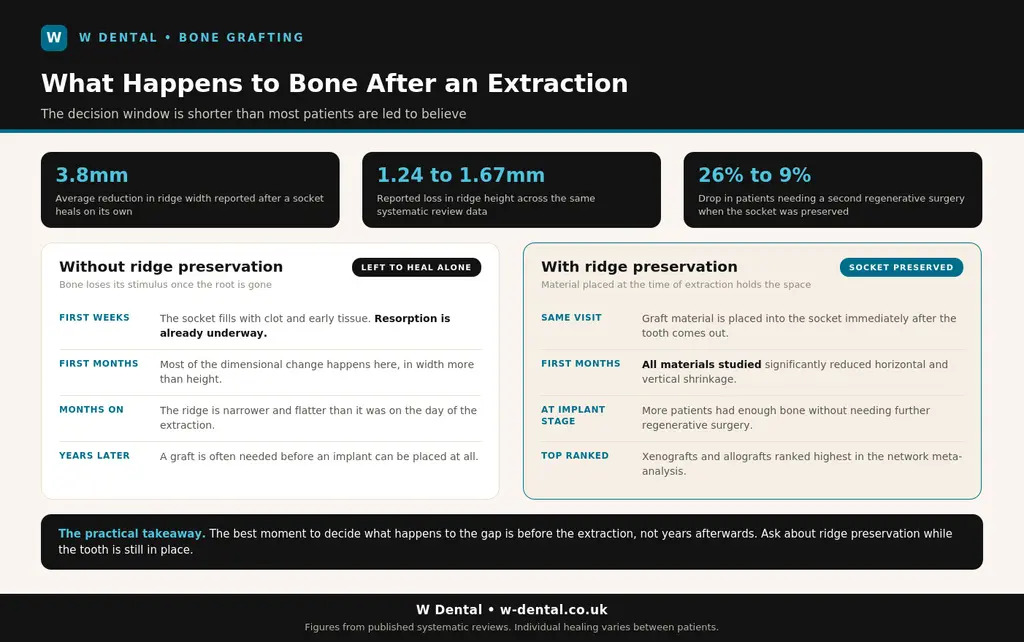
The numbers are higher than most people expect. Systematic reviews of socket healing after extraction describe a reduction in the ridge width of approximately 3.8 mm, with a loss of height of between 1.24 and 1.67 mm.
Most of this change occurs in the first few months. That’s why the decision on what to do with the gap is ideally made before extraction, not years later.
Other causes of bone loss include advanced gum disease, trauma, chronic infections, and long-term denture wear.
Types of Bone Graft
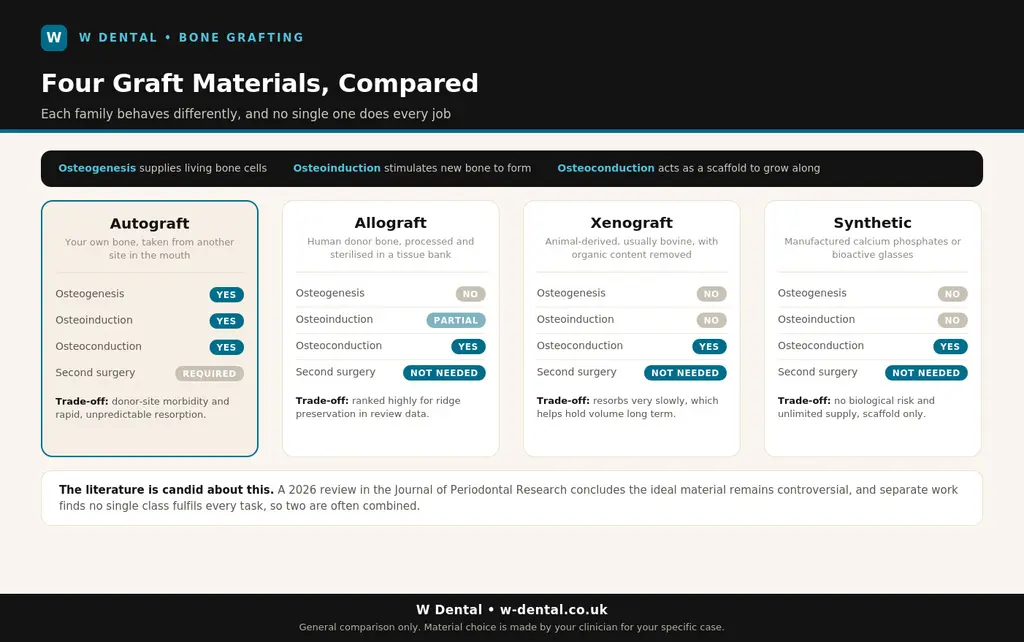
The usual classification distinguishes four types, and they are compared according to three properties: osteogenesis (supplying living cells), osteoinduction (stimulating bone formation) and osteoconduction (acting as a structure).
Autograft
The patient’s own bone, taken from another area of the mouth. It is the only one that provides living cells and inducers, but it requires a second surgical site, and its reabsorption can be rapid and unpredictable.
Allograft
Human donor bone, processed and sterilised in a tissue bank. Avoids the second surgery and retains some osteoinductive capacity.
Xenograft
Animal-derived, usually bovine, treated until all organic components are eliminated. It is reabsorbed very slowly, which helps to maintain volume over the long term.
Synthetic or alloplast
Manufactured materials, such as calcium phosphates or bioactive glasses. No biological risk and unlimited availability, although they only act by osteoconduction.
| Graft Type | Osteogenesis | Osteoinduction | Osteoconduction | Second Surgery |
| Autograft | Yes | Yes | Yes | Yes |
| Allograft | No | Partial | Yes | No |
| Xenograft | No | No | Yes | No |
| Synthetic | No | No | Yes | No |
Types of Bone Graft Procedure
The procedure name depends on where and why the graft is placed.
- Alveolar preservation:
The socket is filled just after an extraction to limit subsequent resorption.
- Guided bone regeneration:
Material is added along with a membrane that prevents soft tissue from invading the space meant for the bone.
- Maxillary sinus elevation:
Height is gained in the upper back jaw by raising the sinus membrane and grafting beneath it.
- Block graft:
A solid fragment of bone, usually of the patient’s own, is fixed in place when the defect is large.
What The Research Says About Bone Graft
A 2026 review on bone grafts shows the four material families and comes to the conclusion that the choice of ideal material remains controversial.
The authors note that autografts provide living cells and inductive factors at the expense of donor morbidity and rapid and unpredictable resorption. They also identify limited osteoinduction of many materials, poor vascularisation, and unbalanced reabsorption as outstanding challenges.
On ridge preservation specifically, a meta-analysis found that bone graft materials reduced horizontal and vertical contraction of the border compared with spontaneous healing, with xenografts and allografts ranking highest.
Step-by-step Bone Graft Process
1. Review:
Examination, scans, and 3D imaging are used to measure available bone and plan the required volume.
2. Surgery:
The area is accessed under local anaesthesia, the material is placed, and, where appropriate, a membrane.
3. Healing:
The body progressively replaces the graft with its own bone over several months.
4. Reassessment:
A new scan confirms whether the volume allows the implant to be placed.
5. Implant placement:
Carried out as any implant would be, now into consolidated bone.
Recovery and Care For Bone Grafts
It is normal to notice swelling, some bruising, and discomfort during the first few days. They are controlled with regular painkillers and a cold compress.
- Sleep with your head raised
Sleep with your head slightly raised for the first few nights.
- Start with soft foods
Eat soft, cold food at first, chewing on the opposite side.
- Avoid smoking
Do not smoke, because tobacco compromises the blood supply that the graft depends on.
- Protection during sinus lift
Avoid blowing your nose forcefully if you’ve had a sinus lift.
- Avoid touching the graft
Do not touch the area of the graft with your tongue or fingers.
- Watch for warning signals
Seek medical help if inflammation increases after three days or fever develops.
How Much Does a Bone Graft Cost?
At W Dental, prices for bone grafts start as follows:
- Bone graft, per area: from £750
- Single implant with crown included: from £2,750
- Implant bridge, per arch: from £8,995
- Simple extraction: from £250
- First consultation with scan, X-rays and plan: £65
Funding is available at 0%. The final price depends on the size of the defect, the material chosen and whether it is performed in the same surgery as the implant.
Conclusion
A bone graft is a step that makes an implant possible once the bone no longer provides support. The research supports its effectiveness and, at the same time, makes it clear that no material solves all scenarios. The useful questions before accepting the budget are what material will be used and why, how long the wait will be, and if the graft can be done in the same surgery as the implant.
(General dental information only. The suitability of treatment, timelines and prices can only be confirmed by a professional after a clinical assessment.)
FAQs
Does bone graft hurt?
The procedure is done with local anaesthesia, so it shouldn’t hurt during the procedure. Subsequent discomfort is usually moderate and lasts a few days.
How long before the implant can be placed?
It depends on the size of the defect and the material, but usually between four and nine months.
Can a bone graft fail?
Yeah. Smoking, infections and insufficient blood supply are the factors most associated with failure. In that case, it can be repeated.
Can a bone graft be done at the same time as the implant?
For small defects, yes. For larger ones, the two stages are usually separated.
Is donor or animal-derived bone safe?
Materials are processed and sterilised under strict regulations. Talk to your professional if you have religious or personal doubts, because there are synthetic alternatives.
What if I don’t get the graft?
Without enough bone, an implant cannot be placed. Alternatives would be a conventional bridge or removable denture.
 Recent Blogs
 Book Your Visit