



If a dentist has told you that you need a crown, the immediate questions are usually the same: is it really necessary, what does it involve, and how much is this going to cost. A crown is a bigger commitment than a filling, so those are fair questions to ask before agreeing to anything.
This guide covers what a crown actually does, the situations that call for one, how the two main materials differ, what the process involves from first appointment to final fit, and realistic costs. The aim is to give you enough detail to have a proper conversation with your dentist.
What a Dental Crown Actually Does
A Dental crown sits over the whole visible portion of a tooth, rather than filling a hole within it. Think of it as a protective shell that takes over the job the original tooth structure can no longer do reliably on its own.
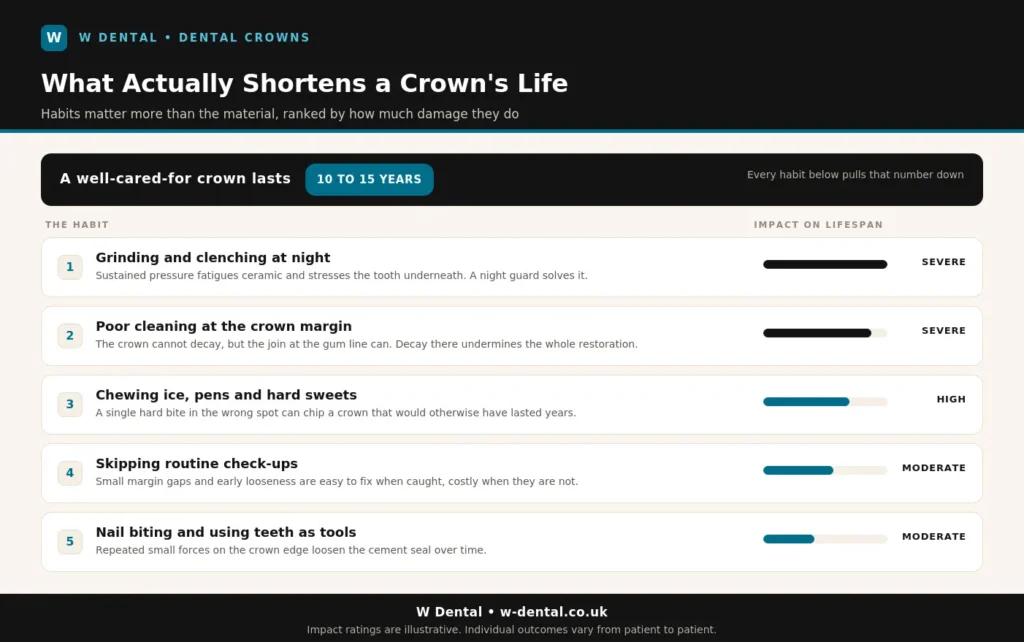
That distinction matters, because it explains why crowns are recommended in some situations and not others. A filling replaces missing tooth material and relies on the surrounding tooth to hold it in place. Once too much of the natural tooth is gone, there is not enough structure left to support a filling, and the tooth becomes prone to fracturing under normal biting force. A crown solves that by wrapping the tooth and redistributing the load.
Crowns also do cosmetic work. Because they are made to match the colour, translucency and shape of your surrounding teeth, they can improve the look of a discoloured or misshapen tooth at the same time as protecting it.
When Do You Actually Need a Crown?
A crown is usually recommended in these situations:
- A cracked or fractured tooth that needs holding together
- A tooth with a very large existing filling, where little natural structure remains
- A tooth that has had root canal treatment, which leaves it more brittle
- Significant wear from grinding, where the tooth has lost height
- A tooth that is badly shaped or discoloured and would not respond well to whitening or bonding
- An implant or bridge that needs a crown fitted on top
There are also cases where a crown is not the right answer. If the damage is minor and there is plenty of healthy tooth left, a filling or composite bonding is usually the more conservative choice. If the concern is purely cosmetic and the tooth underneath is sound, veneers may achieve the result while removing less tooth structure.
Crown, Veneer or Filling: What’s the Difference?
These three treatments are often confused, and the difference comes down to how much of the tooth is involved.
| Factors | Filling | Veneer | Crown |
| Covers | A cavity or small area | Front surface only | The entire tooth |
| Tooth removed | Just the decay | A thin layer of enamel | Reshaped on all sides |
| Main purpose | Repair small damage | Cosmetic improvement | Strength and protection |
| Suits | Minor decay or chips | Sound teeth, cosmetic goals | Cracked or heavily filled teeth |
eMax vs Zirconia: Which Crown Material?
W Dental offers two premium ceramic options, and the recommendation depends on where the tooth sits in your mouth.
eMax crowns:
eMax crowns are made from lithium disilicate, a glass ceramic with exceptional translucency. That translucency is what allows light to pass through the crown in the same way it passes through natural enamel, which is why eMax is the usual choice for front teeth and other visible areas.
Zirconia crowns:
Zirconia crowns are stronger. That makes them better suited to molars and premolars, which absorb the heaviest chewing forces. Modern zirconia is also far more natural-looking than older metal-based crowns, with a clean white finish rather than the grey tinge those used to show at the gum line.
| Factors | eMax | Zirconia |
| Material | Lithium disilicate glass ceramic | Zirconium dioxide |
| Strength | High | Higher |
| Translucency | Excellent, closest to enamel | Good, natural white finish |
| Best position | Front teeth and visible areas | Molars and premolars |
| Price from | £850 per tooth | £950 per tooth |
Neither material is universally better. The right one depends on the position of the tooth, how much force it takes, and how visible it is when you smile.
Dental Crown Process at W Dental
The process at W Dental runs across four stages.
- The consultation:
The tooth is assessed, your goals are discussed, and a crown material is recommended for your specific situation. This appointment is free.
- The preparation:
The tooth is shaped to receive the crown, using digital scanning rather than putty impressions. Local anaesthetic is used throughout, so the appointment should be comfortable.
- The trial:
Before anything is permanently cemented, you try the crown in and approve it. Adjustments to fit, shape and colour are made at this stage, not afterwards.
- The fitting:
The crown is cemented into place. Most patients leave the same appointment with the finished result.
How Long Do Crowns Last?
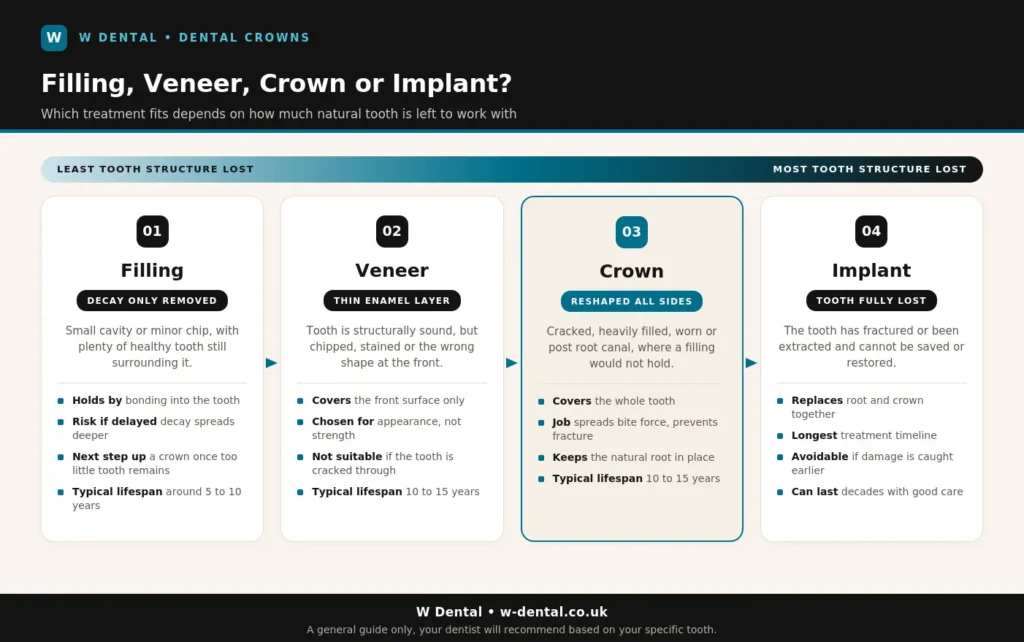
With good oral hygiene and regular check-ups, crowns typically last 10 to 15 years, and many last considerably longer. They are designed as a long-term restoration rather than a lifelong one, so replacement at some point is normal rather than a sign something went wrong.
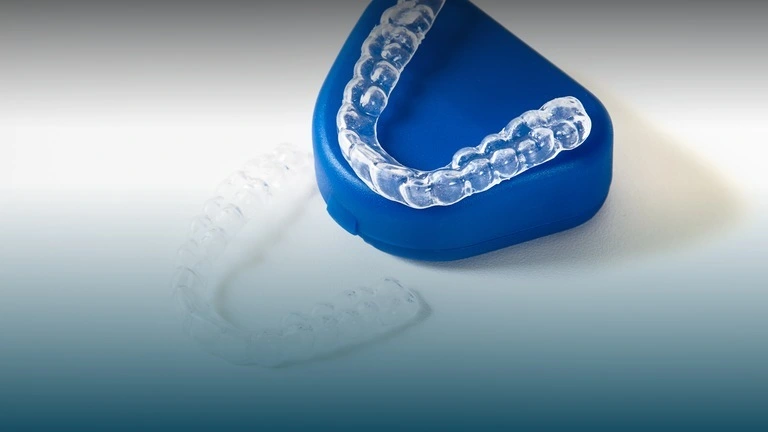
What shortens a crown’s life is usually habit rather than material. Grinding, nail biting and chewing hard objects all put stress on the crown and the tooth beneath it. If you grind at night, mention it, since a night guard is a straightforward way to protect the work.
The Tooth Under a Crown Can Still Decay
This surprises people. The crown itself will not decay, but the margin where it meets the natural tooth is vulnerable if plaque builds up there. That is why brushing and flossing around a crowned tooth matters just as much as anywhere else.
What Do Dental Crowns Cost in London?
At W Dental, pricing currently starts as follows:
- Consultation: free (welcome offer)
- eMax crown: from £850 per tooth
- Zirconia crown: from £950 per tooth
0% finance is available on combined treatment plans over £500. Your exact cost depends on the tooth, the material and whether any other work is needed first, and is confirmed before treatment begins.
It is worth weighing the cost against the alternative. A crown is more expensive than a filling, but a tooth that fractures because it was left unprotected often ends up needing extraction, then an implant or bridge, which costs considerably more than the crown would have.
Conclusion
A crown is one of the more significant treatments in general dentistry, but the reasoning behind it is straightforward: once a tooth loses enough structure, protecting what remains is cheaper and less disruptive than replacing the tooth later. The decisions worth discussing are which material suits the tooth in question and whether a less invasive option would do the job just as well. Both are questions a dentist can answer properly only after seeing the tooth.
(General dental information only. Whether a crown is right for your tooth, and which material suits it, can only be confirmed by a dentist after an assessment.)
FAQs
What is the difference between eMax and Zirconia?
eMax offers superior translucency and suits front teeth where appearance matters most. Zirconia is stronger and better suited to back teeth carrying a heavy chewing load. Your clinician will recommend based on the tooth’s position and your goals.
Are dental crowns permanent?
They are permanently cemented and designed as a long-term restoration, but they are not lifelong. Most last many years before needing replacement.
Does getting a crown hurt?
The preparation is done under local anaesthetic, so you should not feel pain during the appointment. Some tenderness afterwards is normal and settles within a few days.
Can a crowned tooth still get decay?
Yes. The crown will not decay, but the tooth beneath and the margin at the gum line can, which is why regular brushing, flossing and check-ups still matter.
Can crowns be placed next to each other?
Yes. Neighbouring teeth are commonly crowned together, with each one individually designed so the fit and appearance stay natural.
Can a crown be replaced?
Yes. Crowns can be replaced if they become worn, loose or damaged. Your dentist will assess whether repair or replacement makes more sense.
 Recent Blogs
 Book Your Visit