


Finishing braces or aligners feels like the end of treatment. It is not. It is the point where the job changes from moving teeth to keeping them where they are, and that second job has no finish line.
Most people underestimate this. The retainer gets worn diligently for a few months, then occasionally, then it sits in a drawer, and eighteen months later the front teeth have started to crowd again. This guide covers why that happens, which retainer types exist, what the research actually says about how long to wear them, how to look after them, and what they cost.
Why Teeth Move Back Without a Retainer
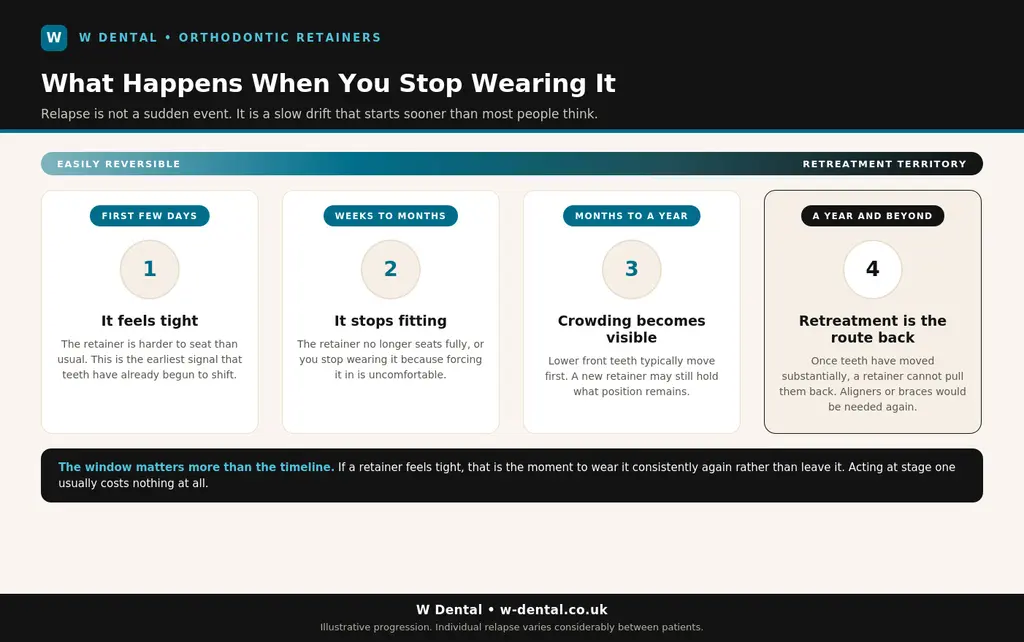
Teeth are held in place by periodontal ligament fibres, and those fibres have elastic memory. After orthodontic treatment, they pull the teeth back toward where they started. Bone remodelling around the new positions takes time, and the soft tissue takes longer still.
The Cochrane review on retention puts it plainly: without a retention phase, teeth tend to return to their initial position, and almost everyone who has orthodontic treatment will require some form of retention.
There is also natural age-related change. Lower front teeth tend to crowd slightly with age regardless of whether you ever had braces. Retention does not stop ageing, but it holds the correction you paid for.
Types of Retainer
There are two broad categories, and many people end up with one of each.
Fixed retainers
A thin wire bonded to the inside surface of the front teeth, usually the lower six. It stays in place permanently and works without you having to remember anything. The trade-off is cleaning, since flossing around a bonded wire takes more care, and the possibility of the bond failing without you noticing.
Essix retainers
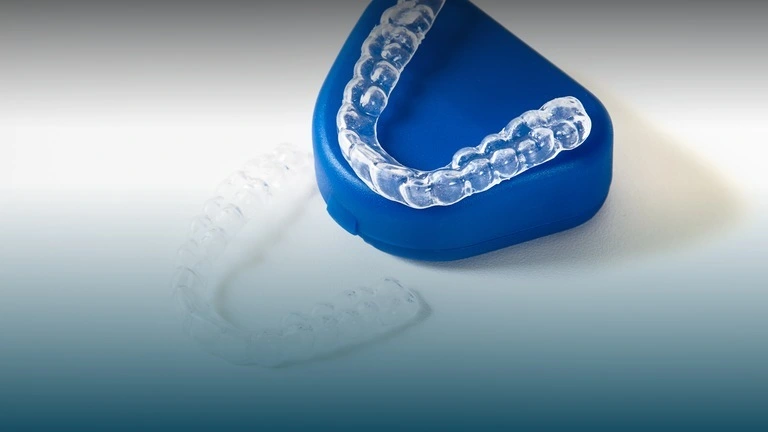
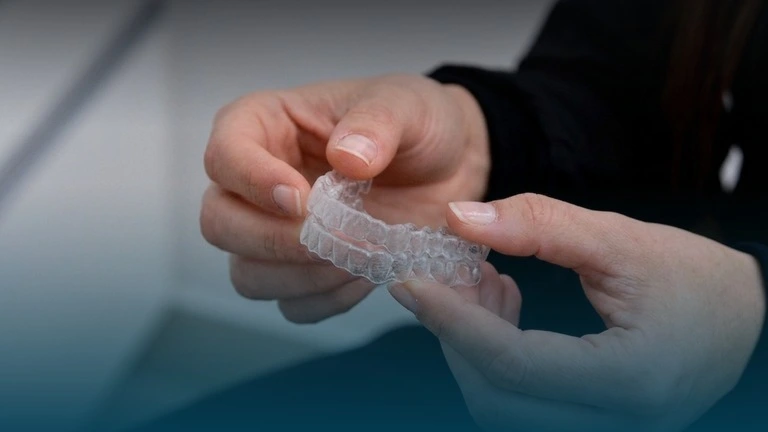
Clear, thin, vacuum-formed plastic trays covering the full arch. They look similar to aligners, are removable, and are the most common removable option. They are also the most affordable and the most likely to be lost.
Vivera retainers
A premium clear retainer made by the manufacturer of Invisalign, supplied as a set of multiple retainers so you have replacements built in. The material is more durable than standard clear retainers, which matters over years of nightly wear.
Hawley retainers
The traditional design with a wire across the front of the teeth and an acrylic plate against the palate. Robust and adjustable, though more visible than clear alternatives.
| Factors | Fixed | Essix | Vivera | Hawley |
| Visible | No, behind teeth | Barely | Barely | Yes, front wire |
| Removable | No | Yes | Yes | Yes |
| Compliance needed | None | Nightly | Nightly | Nightly |
| Cleaning | Harder, floss threaders | Simple | Simple | Simple |
| Durability | Bond can fail | Lower | Higher | High |
| Cost from | £350 each | £250 each | £695 for three | Varies |
What the Research Says About Fixed Retainers
Fixed retainers get sold as the option you can forget about. The research suggests they need more attention than that.
A 2023 systematic review on failure of fixed orthodontic bonded retainers found an overall failure rate of around 35, and crucially, that failure rises the longer the retainer is in place: roughly 24% at short-term follow-up, 40% at medium-term, and 54% at long-term follow-up.
Failure here means a bond coming loose, wire fracture or partial detachment, not necessarily the retainer falling out entirely. A long-term study on survival of maxillary and mandibular bonded retainers following patients 10 to 15 years after treatment found that despite failures along the way, 98.9% of mandibular and 97.6% of maxillary retainers were still in place, because failures had been repaired.
The practical takeaway is that a fixed retainer is not maintenance-free. It needs checking at routine appointments, and a partially detached wire can allow individual teeth to move while everything looks fine from the front.
How to Clean and Care for a Retainer
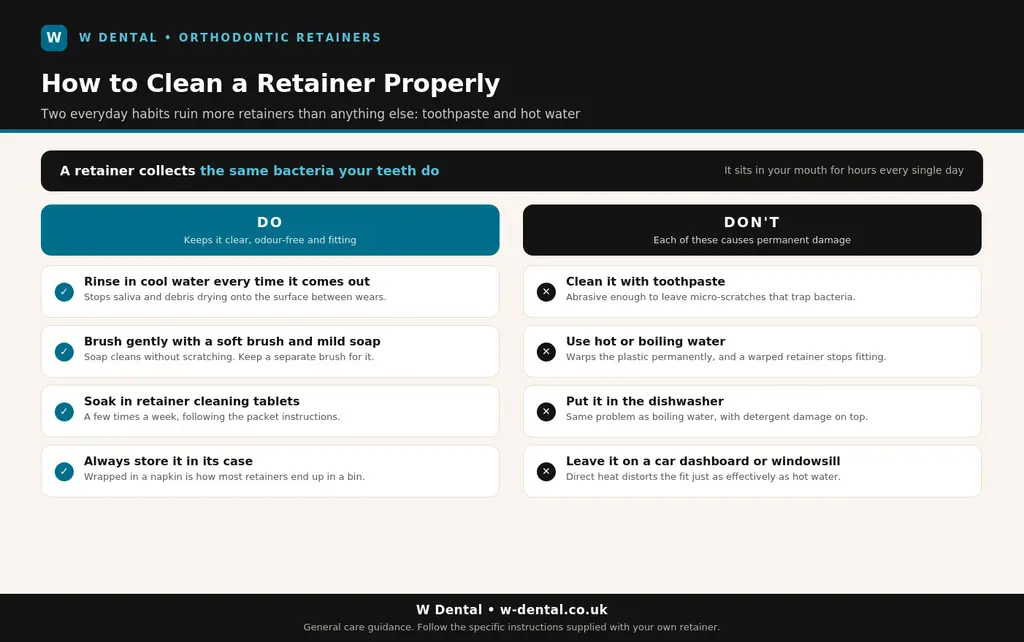
Retainers live in your mouth for hours every day and collect the same bacteria your teeth do.
- Rinse in cool water every time you take it out
- Brush gently with a soft toothbrush and mild soap, not toothpaste, which is abrasive and creates micro-scratches that trap bacteria
- Soak in a proper retainer or denture cleaning tablet solution as directed, usually a few times a week
- Never use hot water, boiling water or a dishwasher, all of which warp the plastic permanently
- Always store it in its case, never wrapped in a napkin, which is how most retainers end up in a bin
- Keep it away from pets, since dogs find them irresistible
- For fixed retainers, use floss threaders or interdental brushes to clean under the wire daily
Common Mistakes with Retainers
Wearing it only when teeth feel tight:
If it feels tight, teeth have already moved. Tightness is a signal you have been slipping, not a reason to wear it just occasionally.
Assuming a fixed retainer means you are covered:
Bonds fail silently. Have it checked at every routine appointment.
Leaving it in hot water or a car dashboard:
Warped plastic no longer fits, and a retainer that does not fit does not retain.
Not replacing a lost retainer promptly:
Teeth begin moving within days. Getting a replacement quickly is far cheaper than repeating treatment.
What Do Retainers Cost?
At W Dental, retainer pricing currently starts as follows:
- Essix retainer: from £250 each
- Fixed retainer: from £350 each
- Vivera retainers, premium clear, set of three: from £695
Conclusion
Retainers are the least glamorous part of orthodontic treatment and the part that determines whether the rest of it holds. The evidence is clear that relapse is the default without retention, and less clear about the ideal schedule, which is why following the plan your own clinician sets matters more than any general rule. Budget for retainers, wear them, get them checked, and replace them when they wear out.
(General dental information only. Your own retention plan should be set by the clinician who carried out your treatment.)
FAQs
How long do I need to wear my retainer?
Most clinicians advise indefinite night-time wear. Early on, wear is usually more frequent, reducing over time according to your own plan.
What if I stopped wearing my retainers years ago?
See a dentist. If the movement is minor, a new retainer may hold what remains. If teeth have shifted significantly, retreatment may be the only route back.
Can I whiten my teeth while wearing retainers?
Clear retainers are not whitening trays and should not be used with whitening gel unless a dentist has specifically advised it.
Do retainers hurt?
No, though a new one or one you have not worn in a while can feel tight for the first night or two.
How often should retainers be replaced?
Removable retainers wear out, typically after a few years depending on care and grinding. Replace them once they crack, warp or stop fitting closely.
Can I have both types?
Yes, and it is common. A fixed retainer on the lower front teeth with a removable retainer worn at night on top is a frequent combination.
 Recent Blogs
 Book Your Visit