


Few treatments have a worse reputation than the root canal. Most of that reputation was earned decades ago, before rotary instruments, better anaesthetic technique and magnification changed how the procedure is done.
This guide covers what the treatment involves, the signs you might need one, what the research says about pain and success rates, what it costs in the UK, and how it compares with the alternative of losing the tooth altogether.
What is a Root Canal Treatment?
Inside every tooth is a soft core called the pulp, containing nerves and blood vessels. When decay, a crack or trauma lets bacteria reach that pulp, it becomes inflamed or infected. Unlike most tissue in the body, pulp sits inside a rigid chamber with no room to swell, which is why the pain can be severe and why the infection rarely resolves on its own.
Root canal treatment, known clinically as endodontic treatment, removes that pulp, cleans and shapes the canals running down each root, then fills and seals them. The tooth stays in place. What it loses is the nerve supply, which is why a root-treated tooth no longer feels hot or cold.
The British Endodontic Society describes the aim simply: to save a tooth that would otherwise need to be taken out.
Signs You Might Need a Root Canal
Symptoms vary, and some people have none at all, which is one reason routine check-ups and X-rays matter. Common signs include:
- Persistent toothache, particularly a deep throbbing ache
- Pain that lingers for more than a few seconds after something hot or cold
- Pain when biting or applying pressure
- A tooth that has darkened compared with its neighbours
- Swelling or tenderness in the gum near the tooth
- A recurring pimple-like spot on the gum, which is a draining abscess
- Facial swelling, which needs urgent attention
Not every toothache means a root canal, and a dentist will confirm with clinical tests and an X-ray rather than symptoms alone.
Does a Root Canal Hurt? What the Evidence Says
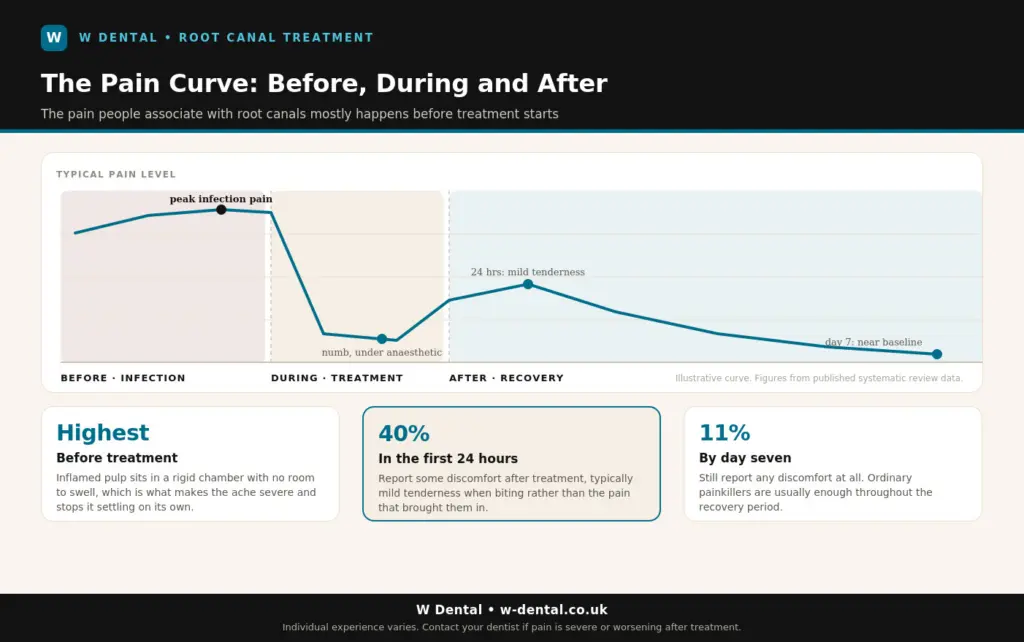
The treatment itself is carried out under local anaesthetic, so the procedure should feel comparable to having a filling placed. What the evidence shows is that the pain associated with root canals is mostly pre-treatment pain from the infection, and it drops sharply once treatment begins.
A prospective study on postoperative pain after root canal found the prevalence of pain in the first 24 hours after treatment was around 40%, falling to roughly 11% by day seven. That post-treatment discomfort is usually mild, described as tenderness on biting rather than the pain that brought people in, and responds to ordinary painkillers.
Technique matters too. A 2018 systematic review and meta-analysis on root canal pain with different instruments of 17 trials found patients treated with rotary instruments had a significantly lower incidence of post-operative pain than those treated with manual instruments.
Steps in Root Canal Procedure
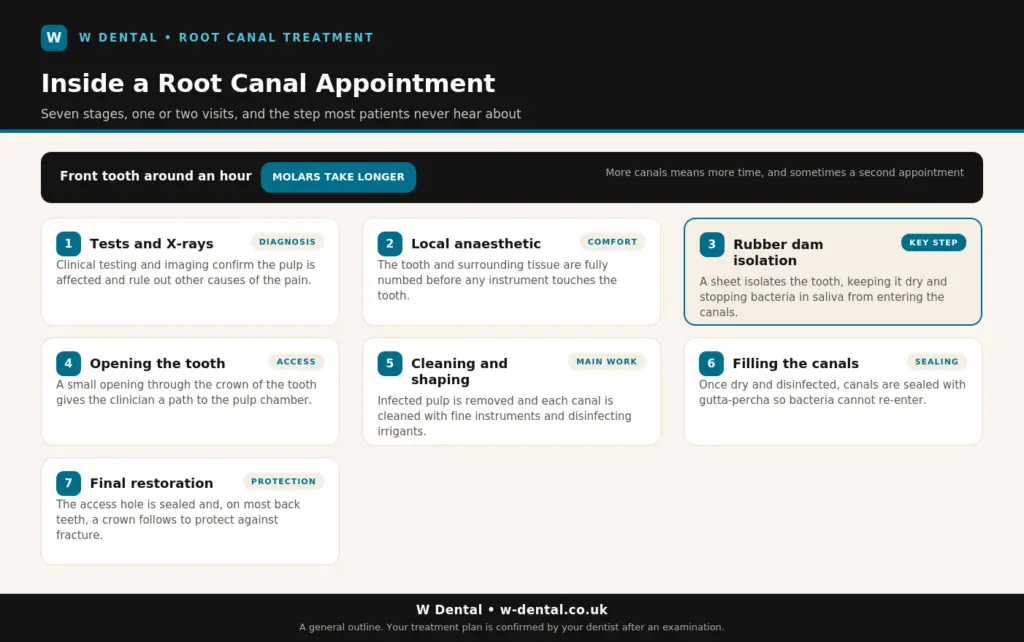
The process typically runs over one or two appointments, depending on the tooth and the level of infection.
- Diagnosis:
Clinical tests and X-rays confirm the pulp is affected and rule out other causes.
- Anaesthetic:
The tooth and surrounding area are numbed thoroughly before anything begins.
- Isolation:
A rubber dam is placed to keep the tooth dry and stop bacteria from saliva entering the canals.
- Access:
A small opening is made through the crown of the tooth to reach the pulp chamber.
- Cleaning and shaping:
The pulp is removed and the canals are cleaned with fine instruments and disinfecting irrigants.
- Filling:
Once dry and disinfected, the canals are sealed, usually with a rubber-like material called gutta-percha.
- Restoration:
The access hole is sealed, and in most cases a crown follows to protect the tooth long term.
Molars have more canals than front teeth and take longer. A front tooth may be finished in around an hour, while a molar can take considerably longer or be split across two visits.
Root Canal vs Losing the Tooth
The honest comparison is not root canal versus doing nothing. It is root canal versus losing the tooth and replacing it.
| Factors | Root canal + crown | Extraction + implant |
| Keeps natural tooth | Yes | No |
| Typical visits | 2 to 3 | 3 or more, over months |
| Timeline | Weeks | Several months, with healing time |
| Cost at W Dental | From £1,700 | From £3,000 |
| Preserves jawbone | Yes, root stays in place | Implant needed to maintain bone |
| Main downside | Tooth is more brittle, needs a crown | Longer, more invasive, more expensive |
Keeping your own tooth also preserves the root, which maintains the surrounding jawbone in a way that an extraction alone does not.
Root Canal Recovery and Aftercare
Some tenderness for a few days is normal, particularly when biting. Over-the-counter painkillers are usually enough. Contact your dentist if pain is severe, worsening after the first couple of days, or accompanied by swelling.
Until the permanent restoration is placed, chew on the other side. A temporary filling is not built to take full biting force, and a root-treated tooth without proper coverage is vulnerable to cracking.
Longer term, a root-treated tooth needs the same care as any other. It cannot get toothache in the way it used to, since the nerve is gone, but the tooth can still decay at the margins and the surrounding gum can still develop disease.
What Does a Root Canal Cost in the UK?
At W Dental, root canal treatment starts from £850 per tooth, with the exact cost depending on which tooth is involved and how many canals it has. A crown afterwards starts from £850 for eMax or £950 for Zirconia.
Emergency appointments at W Dental start from £95 on weekdays and £125 at weekends, plus the cost of any treatment needed. 0% finance is available on treatment plans over £500.
Conclusion
Root canal treatment has a reputation built on how dentistry used to be, not how it is now. Done under anaesthetic with modern instruments, it is a routine way of keeping a tooth that would otherwise be lost, with survival rates the research puts in the high eighties to low nineties over a decade. The two decisions that matter most are not delaying while infection spreads, and following through with a proper restoration afterwards.
(General dental information only. Whether a root canal is right for your tooth can only be confirmed by a dentist after an examination and X-ray. If you have facial swelling or difficulty swallowing, seek urgent dental or medical care.)
FAQs
Does a root canal kill the tooth?
The pulp is removed, so the tooth no longer has a nerve supply and will not respond to hot or cold. The tooth itself stays in place and continues to function.
How many appointments will I need?
Often one or two, depending on the tooth, the number of canals and whether there is active infection.
Can I just take antibiotics instead?
No. Antibiotics may reduce swelling temporarily, but they cannot reach inside the canal system to clear infection there. The source has to be removed.
What if I do nothing?
Infection tends to spread into the surrounding bone, forming an abscess. Extraction usually becomes the only remaining option, and in rare cases the infection can become serious enough to require hospital care.
Will I definitely need a crown?
Not always, particularly on front teeth with limited damage, but on molars a crown is usually recommended, and the research supports it.
Can a root canal be redone?
Yes. Retreatment is possible if the original treatment fails or a new infection develops, though success rates are somewhat lower than for first-time treatment.
 Recent Blogs
 Book Your Visit