
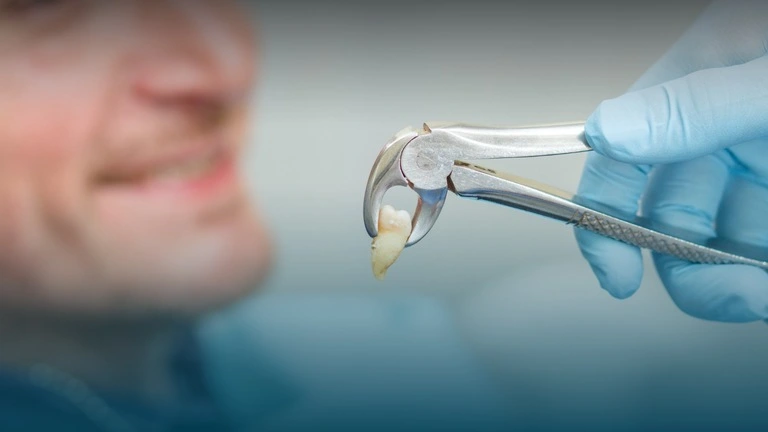



Nobody wants to lose a tooth. If a dentist has told you one needs to come out, it is reasonable to want a second opinion in your own head first: is this actually necessary, what does it involve, and what happens to the space left behind.
This guide covers when extraction is genuinely the right call and when it is not, the difference between a simple and a surgical extraction, what recovery realistically looks like day by day, the one complication worth understanding properly, and what it all costs in the UK.
When is a Tooth Extraction Actually Necessary?
Extraction is a last resort in general dentistry, not a default. These are the situations where it is usually the right call.
Decay too extensive to restore
Once decay has destroyed enough of the tooth that there is nothing solid left to build on, a filling, crown or root canal has nothing to anchor to. At that point, removal becomes the only reliable option.
A fracture below the gum line
A tooth that has broken at or beneath the gum cannot be sealed or rebuilt predictably, because the margin of any restoration would sit below the gum where bacteria can reach it.
Advanced gum disease
When periodontal disease has destroyed the bone holding a tooth in place, the tooth becomes mobile. No restoration fixes a foundation problem, so removal is often the only option once the support is gone.
An impacted wisdom tooth causing problems
An impacted wisdom tooth that is causing infection, decay or damage to the tooth beside it meets the threshold for removal. One causing no problems generally does not, which is covered below.
Crowding before orthodontic treatment
Where there is not enough room in the jaw to align the teeth, a dentist or orthodontist may remove one or more teeth to create the space that treatment needs.
A baby tooth blocking the adult tooth
Occasionally a baby tooth does not fall out on schedule and obstructs the permanent tooth coming through behind or beneath it. Removing it clears the path.
If a tooth can be saved, saving it is almost always preferable. Your own tooth root maintains the bone around it in a way nothing else quite replicates. Before agreeing to an extraction, it is fair to ask whether root canal treatment or a crown could restore the tooth instead.
The Wisdom Tooth Exception
Wisdom teeth are the one area where the UK has clear national guidance, and it may not be what you expect.
The National Institute for Health and Care Excellence recommends that prophylactic removal of pathology-free impacted third molars should be discontinued in the NHS, and that surgical removal should be limited to patients with evidence of pathology. In plain terms, an impacted wisdom tooth causing no problems is generally left alone and monitored rather than removed as a precaution.
Pathology in this context includes untreatable decay, infection, cysts, damage to the neighbouring tooth, or repeated episodes of pericoronitis, the gum inflammation that happens around a partially erupted wisdom tooth.
Simple vs Surgical Extraction
Not all extractions are the same, and the difference affects both the appointment and the cost.
| Factors | Simple extraction | Surgical extraction |
| Applies to | Teeth fully visible above the gum | Impacted, broken below the gum, or unusual roots |
| Method | Loosened and lifted out with instruments | May need an incision, bone removal or sectioning the tooth |
| Typical length | A few minutes to 20 minutes | 30 to 45 minutes or longer |
| Stitches | Usually not needed | Often placed, frequently dissolvable |
| Recovery | Days | Around a week, with more swelling |
| Cost from | £250 | £550 |
Neither is more painful during the procedure, since both are done under local anaesthetic. The difference shows up in the length of the appointment and in recovery.
What Happens During Tooth Extraction Procedure
- Assessment:
An X-ray shows the shape and position of the roots and their relationship to nearby structures such as nerves and sinuses.
- Anaesthetic:
Local anaesthetic numbs the tooth and surrounding tissue completely. You stay awake but feel no pain, only pressure.
- Loosening:
The tooth is gently rocked to widen the socket and separate the fibres holding it in place.
- Removal:
The tooth is lifted out. For surgical cases, this may involve a small incision, removing a little bone, or sectioning the tooth into pieces.
- Closing:
The socket is cleaned. Stitches may be placed, often dissolvable ones.
- Clot formation:
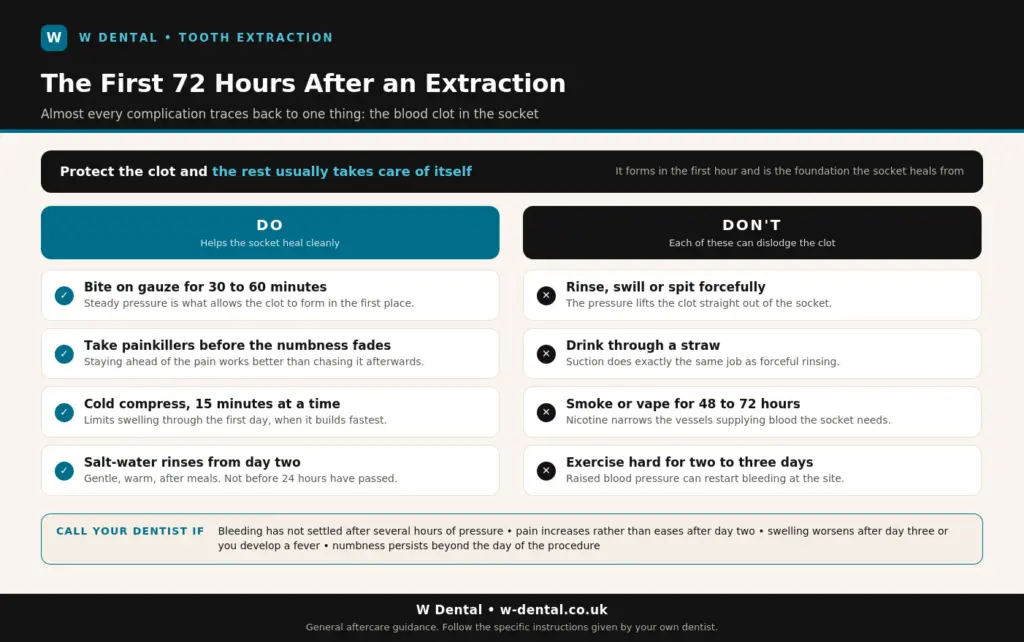
You bite on gauze until a blood clot forms, which is the foundation of everything that follows in healing.
If the thought of any of this makes you uneasy, you are in good company. W Dental’s guide to navigating an appointment as a nervous patient covers the practical options, and IV sedation is available for those who need it.
Recovery After Tooth Extraction
Here is roughly what to expect, though individual recovery varies.
- First 24 hours:
Some bleeding and oozing is normal. Do not rinse, spit forcefully, use a straw or smoke, as all of these can dislodge the clot. Rest, and take painkillers before the anaesthetic wears off rather than after.
- Days 2 to 3:
Swelling typically peaks. Warm salt-water rinses can begin gently. Soft foods only. This is also the window when dry socket, if it develops, tends to announce itself.
- Days 4 to 7:
Discomfort and swelling ease noticeably. Most people return to normal eating on that side within a week to ten days.
- Weeks 2 to 4:
Gum tissue closes over the socket. Bone underneath continues remodelling for several months.
The socket heals from the bottom up, so the surface closing does not mean the process has finished.
Dry Socket: The Complication Worth Understanding
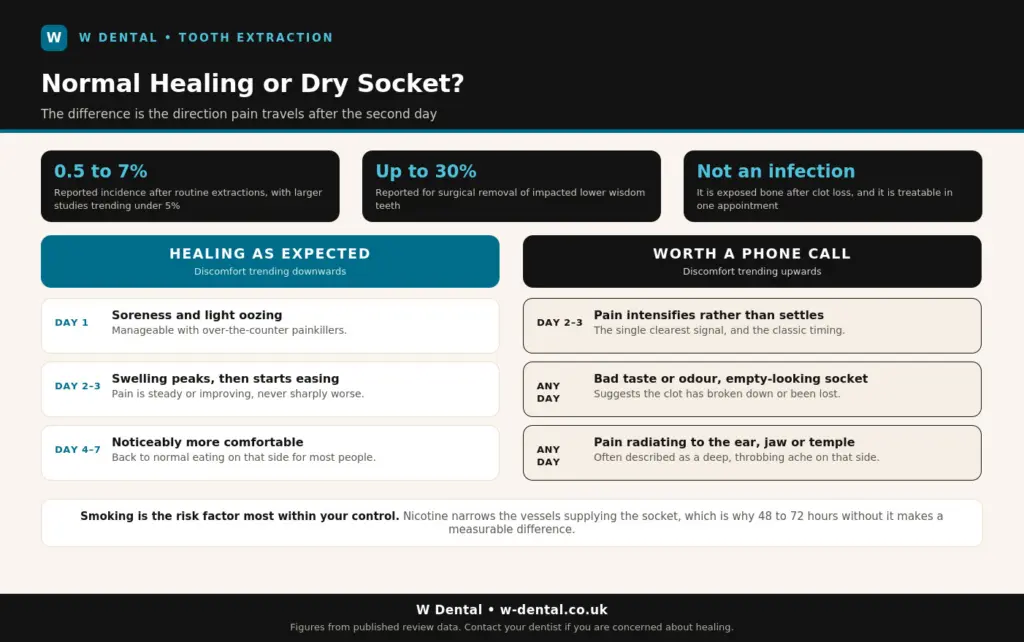
Dry socket, known clinically as alveolar osteitis, happens when the blood clot dislodges or breaks down before the socket has healed, exposing the underlying bone. It is the complication most people have heard of, usually with more dread than the numbers justify.
A Cochrane review on management of alveolar osteitis reports incidence ranging from around 0.5 to 7% for routine extractions, rising considerably for surgical removal of impacted third molars, where reported rates range from 1 to 37.5%. Larger studies on alveolar osteitis tend toward the lower end for routine cases, commonly under 5%.
The sign is pain that gets worse rather than better two to three days after the extraction, often with a bad taste or odour. It is not an infection, and it is treatable. Your dentist can clean and dress the socket, which usually brings relief quickly.
A Prospective Observational Study on Dry Socket Prevalence and Risk Factors shows how smoking is a consistently identified risk factor. Nicotine constricts blood vessels and compromises the blood supply the socket needs to heal. Avoiding smoking for at least 48 to 72 hours after an extraction is one of the more meaningful things within your control.
What Happens to the Gap After Tooth Extraction?
When a tooth is removed, the bone that once held its root begins to shrink, because it no longer has anything to support. Over months and years, this changes the shape of the jaw and can affect the position of neighbouring teeth, which tend to drift into the space.
Back teeth carry most of your chewing load, so a gap there has functional consequences as well as cosmetic ones. Front teeth are usually replaced for obvious reasons.
The main options are an implant, a bridge or a denture. W Dental’s comparison of implants versus bridges sets out how the two differ, and the honest pros and cons of implants are worth reading before committing to either.
What Does a Tooth Extraction Cost in the UK?
At W Dental, extraction pricing currently starts as follows:
- Simple extraction: from £250
- Surgical extraction, including wisdom teeth: from £550
- Emergency appointment: from £95 on weekdays, £125 at weekends, plus treatment
- IV sedation: from £600 per appointment
For replacing the tooth afterwards, implants start from £2,750, bridges from £895 and dentures from £1,500. 0% finance is available on treatment plans over £500.
In England, extractions are available on the NHS under Band 2, with a fixed patient charge reviewed each April, though appointment availability varies considerably by area.
Conclusion
Extraction is a routine procedure with a straightforward recovery for most people, but it is also permanent, which is why the conversation beforehand matters. Two questions are worth asking every time: is there any realistic way to save this tooth, and what is the plan for the space once it is gone. A dentist who answers both properly is giving you what you need to make the decision rather than simply booking you in.
(General dental information only. Whether extraction is right for your tooth can only be confirmed by a dentist after an examination and X-ray. Seek urgent care for facial swelling, difficulty swallowing or bleeding that will not stop.)
FAQs
Does a tooth extraction hurt?
Not during the procedure. Local anaesthetic means you feel pressure and movement but not pain. Some soreness afterwards is normal and usually manageable with over-the-counter painkillers.
How long does it take?
A straightforward extraction can take a few minutes. A surgical extraction, particularly an impacted wisdom tooth, may take 30 to 45 minutes or longer.
When can I eat normally again?
Stick to soft foods for the first few days and chew on the other side. Most people return to normal eating within a week to ten days.
Can I drive myself home?
After local anaesthetic, usually yes. After IV sedation, no. You will need someone to accompany you home and stay with you.
Do I have to replace the tooth?
Not always, particularly for wisdom teeth, which do not need replacing. For other teeth, replacement is worth discussing, since bone loss and drifting are gradual and hard to reverse later.
What if I am nervous about it?
Say so. Sedation options exist, and simply knowing what will happen and when tends to reduce anxiety more than people expect.
 Recent Blogs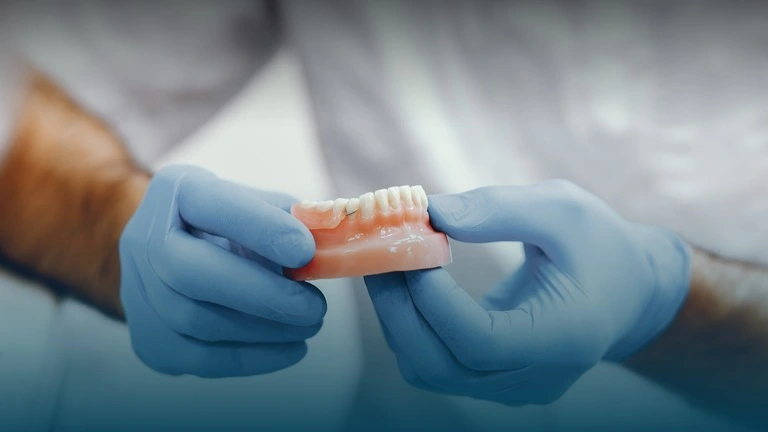
 Book Your Visit