


Most people know they should see a dentist regularly, but far fewer can say what general dentistry actually covers or where it ends and something more specialised begins. It is a fair question, particularly if you have not been to a dentist in a while and are unsure what an appointment involves.
This guide explains what general dentistry includes, what happens at a routine examination, how often the evidence says you should actually attend, and how it differs from cosmetic and specialist care.
What is General Dentistry?
General dentistry is the branch of dental care focused on diagnosing, treating and preventing problems affecting your teeth, gums and mouth. It is sometimes called family or primary dental care, because a general dentist looks after patients of all ages and handles the majority of what people need.
According to the World Health Organization, untreated tooth decay in permanent teeth is the single most common health condition globally, and most oral health conditions are largely preventable and treatable in their early stages. That prevention-and-early-treatment window is precisely what general dentistry exists to work within.
The Three Areas it Covers
Preventive care keeps problems from developing in the first place. This includes examinations, professional cleaning, scale and polish, hygiene appointments, fluoride application and advice on brushing, flossing and diet.
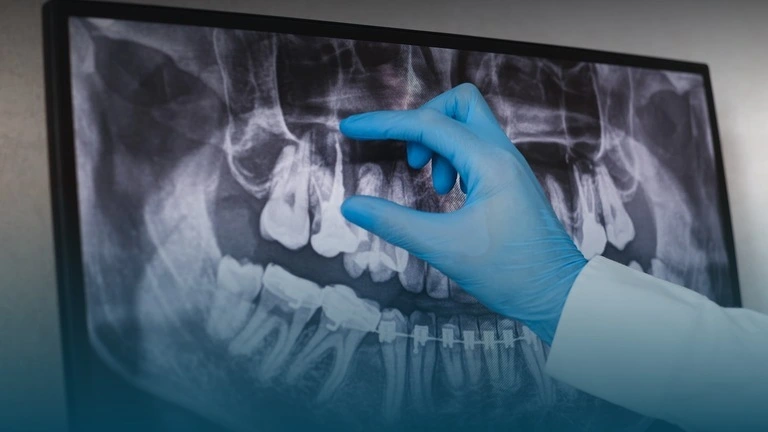
Diagnostic care finds problems you cannot see or feel yet. Digital X-rays reveal decay between teeth and beneath existing fillings, bone loss around the roots, and issues with teeth that have not yet erupted. Soft tissue checks screen for changes that need further investigation.
Restorative care repairs damage once it has happened: fillings, crowns, root canal treatment, extractions and replacing missing teeth.
What’s Included in General Dentistry?
General dentistry covers more ground than most people expect. Here is what sits inside it.
Routine examinations and diagnostics
The check-up is the backbone of everything else. At W Dental that means a 12-point assessment of the teeth, gums and jaw, an oral cancer screening and a gum health evaluation, supported by digital X-rays and high-definition intraoral cameras so you see what the clinician sees rather than taking it on trust. New patients also get a 3D digital scan and a written plan with costs set out upfront.
Hygiene and preventive care
Hygiene appointments handle what brushing cannot. A professional clean removes plaque and hardened tartar below the gum line and between teeth, and airflow polishing lifts staining from coffee, tea and smoking. Prevention also covers fluoride application, dietary advice and interdental cleaning guidance, which is where most routines fall short.
Gum disease treatment
Bleeding gums are the most commonly ignored dental symptom. Treatment ranges from a deeper clean and better home care at the early gingivitis stage through to periodontal treatment once bone loss has begun. Caught early, it is usually reversible. Left alone, it is a leading cause of adult tooth loss.
Fillings and restorative work
When decay has already happened, a filling removes it and rebuilds the tooth, using tooth-coloured composite rather than amalgam so repairs blend in. Where too much structure has been lost for a filling to hold, the work moves to crowns, inlays or onlays.
Root canal treatment
If decay or trauma reaches the nerve, root canal treatment removes the infected pulp, cleans the canal and seals it, saving the natural tooth rather than losing it. It has an unfair reputation. Under local anaesthetic, it is broadly comparable to having a filling placed.
Extractions
Sometimes a tooth cannot be saved, through extensive decay, fracture, advanced gum disease or crowding. Extraction is a last resort, and the conversation usually moves straight on to how the gap will be restored.
Emergency dental care
Toothache, a broken or knocked-out tooth, a lost filling, swelling or dental trauma all sit within general dentistry. Emergency appointments exist because these rarely settle on their own.
Children’s dentistry
General dentists see all ages. Children’s appointments focus on monitoring development, preventing decay and building a comfortable relationship with the chair early, since anxiety often takes hold in childhood.
Care for anxious patients
Dental anxiety is common enough to shape how modern practices are designed. Options run from simply taking more time and explaining each step through to overhead distractions and IV sedation.
What Actually Happens at a Check-up
A thorough examination is more than a quick look. At W Dental, a routine visit includes a 12-point assessment covering the teeth, gums and jaw, along with oral cancer screening and a gum health evaluation, plus digital X-rays and an intraoral camera so you can see what the clinician sees.
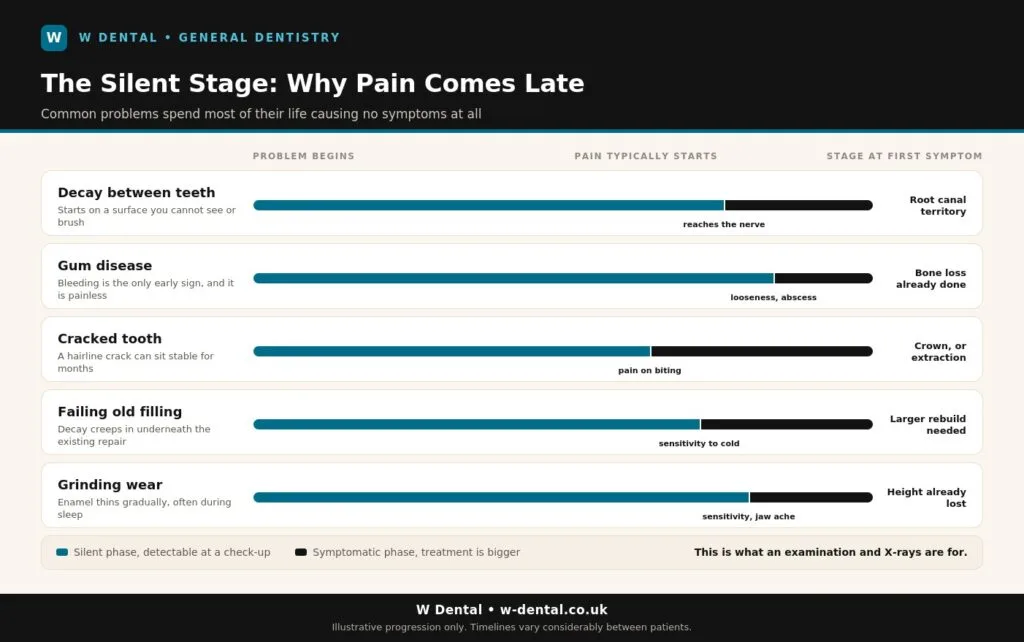
That breadth matters because the most common conditions are silent early on. Decay between teeth causes no pain until it reaches the nerve. Gum disease often progresses without discomfort. By the time something hurts, the simple fix has usually passed.
How Often Should You Actually Go?
This is where the evidence gets interesting, because the familiar six-month rule is not the whole story.
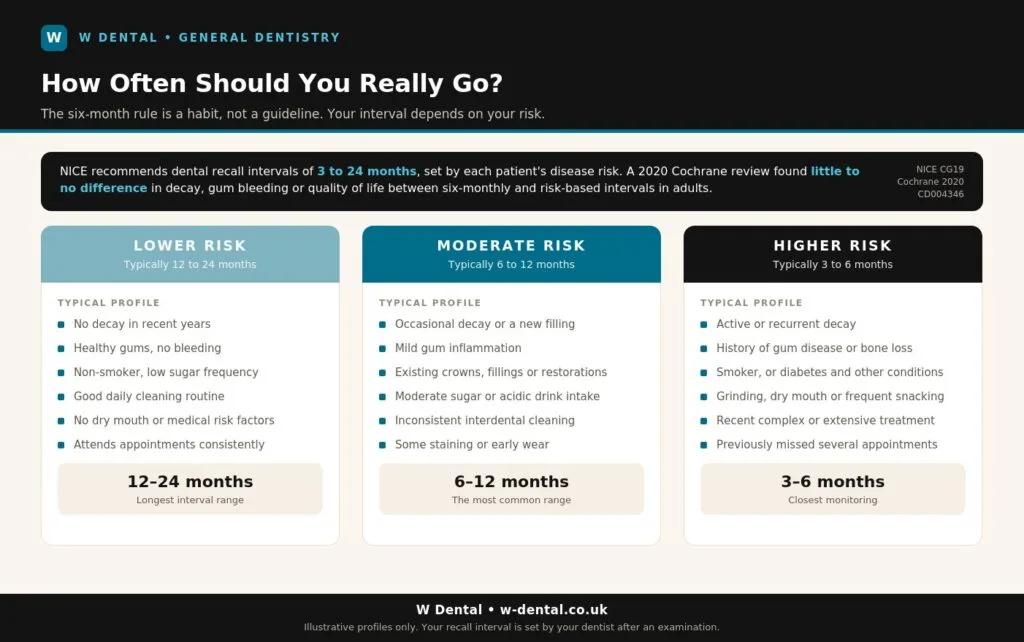
The NICE guideline CG19 recommends that recall intervals be set according to each patient’s disease risk, ranging from 3 to 24 months rather than a fixed 6 months for everyone.
A 2020 Cochrane review on oral health of randomised trials went further. For adults in primary care, it found high-certainty evidence of little to no difference in tooth decay, gum bleeding, or oral health-related quality of life between six-monthly check-ups and personalised risk-based intervals over a four-year period.
The practical takeaway is not that check-ups do not matter. It is that the right interval is individual. Someone with healthy gums, no decay history and low sugar intake may safely attend less often than someone who smokes, grinds their teeth or has a history of gum disease. That assessment is part of what a general dentist does at every visit.
Why Gum Health Matters Beyond Your Oral Health
There is now a substantial body of research linking gum health to general health. A 2020 consensus report on periodontitis and cardiovascular diseases concluded there is consistent epidemiological evidence that periodontitis is associated with an increased risk of atherosclerotic cardiovascular disease, and recommended that patients with gum disease be told their cardiovascular risk is higher.
Similar associations have been reported with diabetes, chronic obstructive pulmonary disease and chronic kidney disease. These are associations rather than proof that treating gum disease prevents heart attacks, and the research is ongoing. But it is a reasonable argument for taking bleeding gums seriously rather than assuming they are normal.
General vs Cosmetic vs Specialist Dentistry
These terms overlap, and clinics use them differently, which adds to the confusion.
| Factors | General Dentistry | Cosmetic Dentistry | Specialist Dentistry |
| Main aim | Health and function | Appearance | Complex or referred cases |
| Typical treatments | Check-ups, hygiene, fillings, root canals | Whitening, veneers, bonding | Orthodontics, oral surgery, implants |
| Who provides it | General dentist | General dentist with cosmetic focus | Registered specialist |
| When you need it | Routinely, throughout life | By choice, for appearance | When referred or for complex needs |
Plenty of treatments sit in both camps. A white filling restores function and looks natural. A crown protects a cracked tooth and improves its appearance. The distinction is about the primary purpose rather than a hard boundary.
What Does General Dentistry Cost?
At W Dental, pricing currently starts as follows:
- New patient consultation: £65, including full clinical exam, digital X-rays and a personalised plan
- Routine adult check-up: £65, including two X-rays
- Children’s check-up: £25
- Hygiene with airflow: £150
- Emergency appointment: from £95, plus treatment fee
- White composite fillings: from £250 per tooth
- IV sedation: £600 per appointment
0% finance is available on treatments over £500. Prices are accurate as of May 2026 and confirmed before treatment begins.
What You Do at Home Still Matters Most
Professional care works alongside your daily routine, not instead of it. A 2019 Cochrane review on fluoride toothpastes of different concentrations confirmed that fluoride toothpaste prevents tooth decay compared with non-fluoride toothpaste, with stronger concentrations preventing more decay, though the choice for young children needs balancing against the risk of fluorosis.
Alongside brushing twice daily with fluoride toothpaste, cleaning between the teeth, limiting how often you consume sugar rather than simply how much, and not smoking are the measures with the strongest evidence behind them.
Conclusion
General dentistry is the unglamorous part of dental care, and also the part that determines almost everything else. Preventing a cavity is cheaper and simpler than filling one, and filling one is cheaper and simpler than a root canal or an extraction. The evidence supports risk-based attendance rather than a rigid schedule, which means the useful question is not how often should anyone go, but how often should you go given your own risk. A general dentist can answer that properly only after an assessment.
(General health information only, not individual clinical advice. Your own recall interval, treatment needs and suitability can only be determined by a dentist after an examination.)
FAQs
Is general dentistry the same as NHS dentistry?
No. General dentistry describes the type of care, while NHS and private describe how it is funded. Both NHS and private practices provide general dentistry. W Dental is a fully private practice.
How long does a check-up take?
At W Dental, the first visit is a 45-minute assessment. Routine check-ups afterwards are typically shorter, though this varies by patient.
Do I need X-rays every time?
Not usually. How often X-rays are taken depends on your risk of decay and your clinical history, which your dentist will assess rather than applying a fixed schedule.
Is a hygienist appointment the same as a check-up?
No. A check-up is an examination and diagnosis. A hygiene appointment is a professional clean, removing plaque and tartar that brushing cannot reach. Many patients need both.
What if I have not been to a dentist in years?
That is more common than most people assume, and it is not a reason to delay further. A first appointment is an assessment, not a lecture, and the point is to establish where things stand and what, if anything, needs doing.
Does a general dentist treat children?
Yes. General dentists see patients of all ages, and W Dental sees children at both clinics in Tooting and Twickenham.
 Recent Blogs
 Book Your Visit