
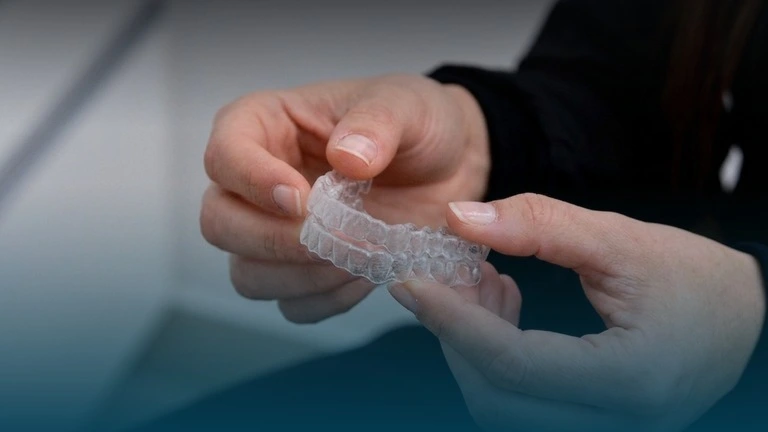


If you are searching for Invisalign® in London, you are choosing between a lot of clinics quoting a lot of different numbers, and it is not always obvious what separates them. The aligners themselves are the same product. What differs is case assessment, planning, how many refinements are included, and what happens once treatment finishes.
This guide covers what Invisalign® actually corrects, what the research says about how it compares with fixed braces, the process from scan to retainer, realistic timelines, and what it costs in London.
What is Invisalign®?
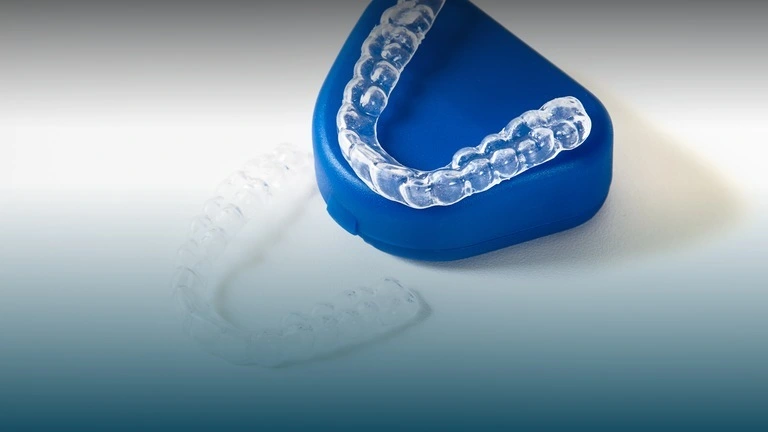
Invisalign® is a clear aligner system. Instead of fixed brackets bonded to your teeth, you wear a sequence of custom-made transparent trays, changing to the next set every one to two weeks. Each set applies gentle pressure to move specific teeth a fraction of a millimetre closer to the planned position.
Small tooth-coloured attachments are often bonded to certain teeth to give the aligners something to grip. These are removed at the end of treatment.
The aligners are removable, which is the practical difference that matters most day-to-day. You take them out to eat, drink anything other than water, and clean your teeth.
Common Issues Invisalign® Can Correct
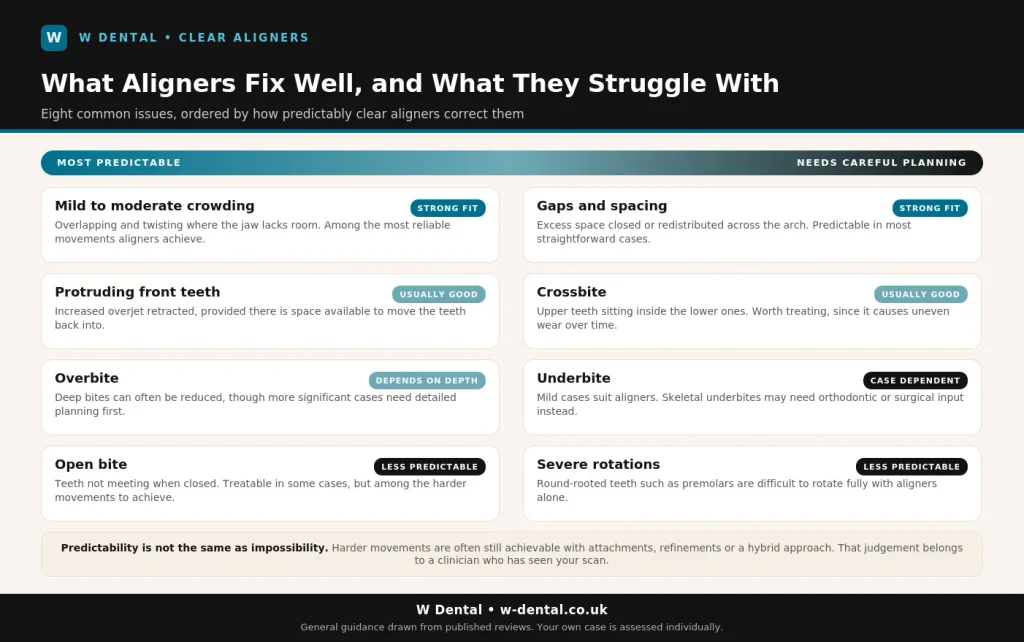
Invisalign® handles a wider range of cases than most people assume, though not all of them equally well.
Crowding
Where there is not enough room in the jaw, teeth overlap and twist. Mild to moderate crowding is one of the most predictable things aligners correct.
Gaps and spacing
Excess space between teeth, whether from jaw size, missing teeth or natural spacing, can usually be closed or redistributed.
Overbite
Where the upper front teeth sit too far over the lower ones. Deep bites can often be reduced, though more significant cases need careful planning.
Underbite
Where the lower teeth sit in front of the upper teeth. Mild cases can be treated with aligners; skeletal underbites may need orthodontic or surgical input.
Crossbite
Where some upper teeth sit inside the lower teeth rather than outside. Left untreated, crossbites can cause uneven wear and gum recession.
Open bite
Where the upper and lower teeth do not meet when the mouth is closed. Treatable in some cases, though it is among the harder movements to achieve predictably.
Protruding front teeth
Teeth angled forward, often described as an increased overjet. Aligners can retract them where space allows.
Rotated teeth
Individual teeth twisted out of line. Correctable, though severe rotations on round-rooted teeth such as premolars are less predictable.
Difference Between Clear Aligners vs Fixed Braces
Both clear aligners and fixed braces can straighten teeth effectively, but they differ in appearance, flexibility, maintenance and the types of tooth movement they are best suited to. The right option depends on your individual orthodontic needs, treatment goals and how consistently you can follow your treatment plan.
| Factors | Clear aligners | Fixed braces |
| Appearance | Clear, hard to notice | Visible brackets and wires |
| Removable | Yes, for eating and cleaning | No |
| Plaque control | Easier, aligners come out | Harder around brackets |
| Best at | Segmented movement, shorter duration | Torque, rotation, occlusal contacts |
| Complex cases | Evidence less settled | Longer track record |
| Depends on | Your wear discipline | Attending adjustments |
What the Research Says About Aligners vs Braces
A systematic review with meta-analyses on aligner outcomes found aligners offered an advantage in the segmented movement of teeth and in shortened treatment duration, while fixed appliances were more effective at producing adequate occlusal contacts and controlling tooth torque and rotation.
A 2025 systematic review and meta-analysis on outcomes with clear aligners vs fixed appliances reached a practical conclusion: both clear aligners and fixed appliances effectively achieve orthodontic treatment goals, and case complexity and patient compliance should guide which one to use.
Aligners do appear to have one clear advantage. An umbrella review of systematic reviews on periodontal status noted that because aligners are removed for meals and cleaning, patients can control plaque more effectively during treatment than they can around fixed brackets.
A Step-by-step Guide to the Invisalign® Process
The process at W Dental runs roughly as follows.
- Free smile consultation:
Your teeth and bite are assessed, and a 3D digital scan produces a preview of the projected result before you commit to anything.
- Treatment planning:
Your clinician maps the sequence of movements and the number of aligners needed.
- Aligners fitted:
Attachments are bonded where needed, your first aligners are fitted, and you are shown how to insert and remove them.
- Progress through the series:
You change aligners every one to two weeks, with periodic check-ins.
- Refinement:
Additional aligners are often used at the end to fine-tune the result.
- Retention:
Retainers are fitted to hold the teeth in their new position.
How Long Does it Take?
Most cases take between 6 and 18 months. Straightforward crowding sits at the shorter end. Bite corrections take longer.
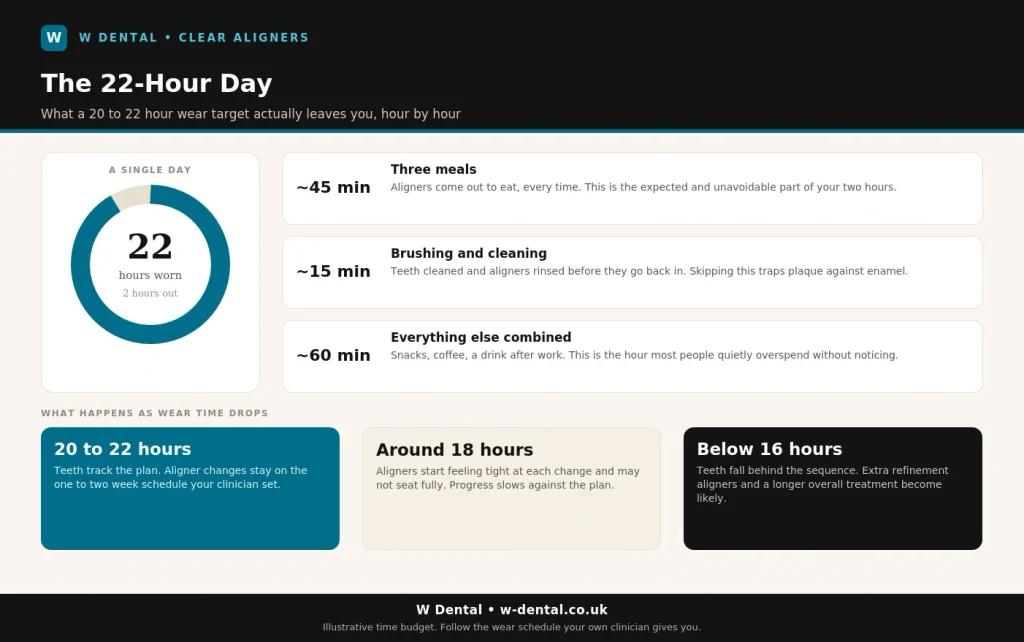
The variable that shifts this timeline most is not your teeth; it is wear time. Aligners need 20 to 22 hours a day. Leaving them out for meals is expected; leaving them out through a busy week is what extends treatment.
If dental anxiety is part of what has held you back, W Dental’s guide to navigating an appointment as a nervous patient is worth reading first.
Why Retainers Matter After Treatment
Teeth do not simply stay where they are moved to. Without retention, they drift back toward their original positions, and this tendency does not fully disappear with time.
At W Dental, retainer options include fixed retainers bonded behind the teeth from £350 each, clear removable Essix retainers from £250 each, and Vivera retainers, a premium clear set of three, from £695.
Budget for retention from the outset rather than treating it as an afterthought. It is the difference between a result that holds and one that gradually undoes itself.
What Does Invisalign® Cost in London?
At W Dental, aligner pricing currently starts as follows:
- Smile makeover consultation, including Invisalign® consults and 3D preview: free
- 32Co aligners, for mild to moderate cases: from £1,500
- Invisalign®, suitable for all case types: from £2,800
- Retainers: from £250 for Essix, £350 for fixed, £695 for a Vivera set of three
0% finance is available on treatment plans over £500. Your exact cost depends on case complexity and the number of aligners required, and is confirmed after your assessment.
If you are still weighing up whether to go ahead at all, our honest pros and cons of Invisalign® for adults cover the decision in more depth.
Conclusion
Invisalign® is a well-evidenced way to straighten teeth, with genuine advantages in comfort, appearance and oral hygiene during treatment, and genuine limitations in the most complex cases. If you are comparing clinics in London, the questions worth asking are not about the brand but about your specific case: what is being corrected, how many aligners, how many refinements are included, and what retention costs. A free consultation with a 3D preview should answer all four before you commit.
(General dental information only. Suitability for clear aligner treatment, expected results and timelines can only be confirmed by a clinician after an assessment.)
FAQs
Does Invisalign® hurt?
It should not be painful. Mild pressure or tenderness for a day or two after changing to a new set is normal and usually settles quickly.
Will people notice when I wear aligners?
Most people do not, unless they look closely. Attachments are tooth-coloured, and the aligners themselves are clear.
Can I drink coffee with aligners in?
No. Only plain water. Hot drinks can distort the plastic and coloured drinks can stain it.
What if I lose an aligner?
Contact your clinic promptly. You may be advised to move to the next set early or wear the previous set while a replacement is made.
Should I whiten before or after Invisalign® treatment?
Usually after, once the attachments are removed and the teeth are in their final positions.
Is Invisalign® better than 32Co aligners?
Neither is simply better. 32Co suits mild to moderate cases at a lower price point. Invisalign® covers a broader range of case types. Your clinician will recommend based on what your teeth need.
 Recent Blogs
 Book Your Visit