


Implants are the most expensive way to replace a missing tooth and, for most people, the most durable. That combination makes the research worth understanding before you commit, rather than after.
This guide covers the types of implant treatment available, what each costs in London, the procedure from assessment to final crown, and what the evidence says about how long implants actually last and what causes them to fail.
What is a Dental Implant?
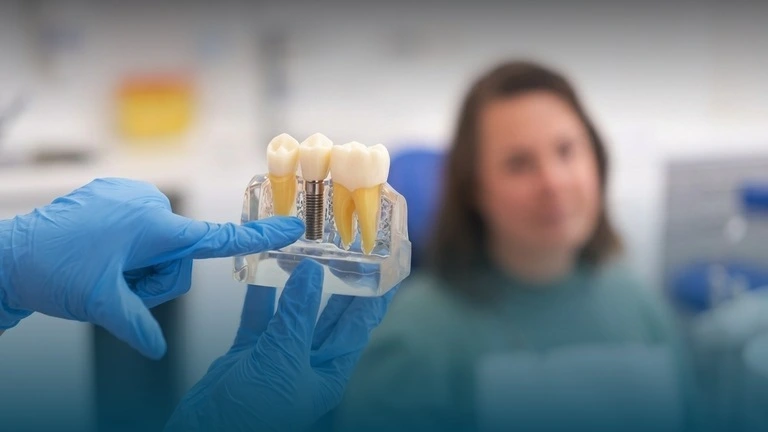
An implant has three parts.
- The fixture is the titanium screw placed into the jawbone, taking the place of the natural root.
- The abutment is the connector that sits on top of it.
- The crown is the visible tooth, made to match your other teeth in shape and shade.
What makes implants different from bridges or dentures is osseointegration, the process where bone grows directly onto the titanium surface and locks it in place. This takes months, and it is why implant treatment is measured in months rather than weeks.
That bone connection is also the functional advantage. When a tooth is lost, the bone that supported it begins to shrink. An implant loads that bone again, which slows the process in a way no other replacement does. If you are weighing implants against the alternative, you need to understand the comparison between implants and bridges.
Types of Dental Implant Treatment
Not every case needs the same solution. The right one depends on how many teeth are missing and where.
1. Single tooth implant
One fixture, one crown, replacing one tooth without touching the teeth on either side. This is the most common treatment and the most straightforward.
2. Implant bridge
Where several adjacent teeth are missing, two or more implants support a bridge spanning the gap. Fewer implants than teeth, which controls both cost and surgical load.
3. All-on-Four
A full arch of teeth supported on four strategically angled implants. Used where most or all teeth in an arch are missing or failing, and often possible without extensive grafting because the angled placement uses available bone.
4. Implant-retained dentures
A denture that clips onto implants rather than resting on the gums. It still comes out for cleaning, but it does not move while eating or speaking, which is the main complaint people have about conventional dentures.
5. Same-day implants
In selected cases, a temporary tooth is fitted at the same appointment as the implant, so you do not leave with a gap. Suitability depends on bone quality and the stability achieved at placement. W Dental offers same-day dental implants where the case allows.
| Treatment | Replaces | Cost from |
| Single implant | One tooth | £2,750 |
| Implant-retained denture | A full arch, removable | £7,500 per arch |
| Implant bridge | Several or all teeth in an arch | £8,995 per arch |
| All-on-Four | A full arch, fixed | £12,500 per arch |
| Bone graft | Rebuilds lost bone first | £750 per area |
Step-by-step Dental Implant Procedure
The process runs across several months, most of which is healing rather than appointments.
- Assessment and planning:
A clinical exam, digital scans and X-rays establish bone volume and the position of nerves and sinuses. This is where suitability is confirmed, and grafting is decided.
- Preparation if needed:
Extractions or bone grafting happen first, with healing time before placement.
- Implant placement:
The fixture is placed into the jawbone under local anaesthetic, with sedation available. This is usually a shorter appointment than people expect.
- Osseointegration:
The bone integrates with the implant over roughly three to six months. A temporary tooth may be worn during this period.
- Abutment and impressions:
Once integrated, the connector is fitted and a digital scan captures the shape for the final crown.
- Final restoration:
The crown, bridge or denture is fitted and the bite adjusted.
The long timeline is not inefficiency. It is the biology of bone healing, and rushing it is the main way implants fail early. Our step-by-step patient guide on dental implants walks through each appointment in more detail.
How Long Do Dental Implants Actually Last?
A systematic review and sensitivity meta-analysis reported implant survival of 96.4% at the implant level. The authors then reran the analysis accounting properly for patients lost to follow-up and arrived at 93.2%, noting a possible doubling of the risk of implant loss in patients aged 65 and over.
Over a longer horizon, a 20-year meta-analysis of dental implant survival rates found survival of 92% across prospective studies, dropping to 78% once missing data was imputed, with retrospective studies at 88%.
The honest reading is that implants have a strong long-term record, that headline figures tend to be the optimistic end of the range, and that survival at 20 years is meaningfully lower than at 10.
What Causes Implants to Fail
Survival means the implant is still in place. It does not mean the surrounding tissue is healthy.
A systematic review and meta-analysis on risk factors and indicators for peri-implant diseases estimated prevalence at the patient level of 46% for peri-implant mucositis and 21% for peri-implantitis, the inflammatory condition that causes bone loss around an implant.
In other words, roughly one in five implant patients develops peri-implantitis at some point. It is treatable, but treatment is not always predictable, which is why hygiene appointments after implant treatment are not optional extras.
Smoking is the risk factor with the clearest evidence behind it. A 2026 systematic review on tobacco smoking and smoke-free products as risk factors for dental implants found significantly reduced implant survival in cigarette smokers at both implant and patient level, along with greater bone loss around the implant. Smoking is not an absolute barrier to treatment, but it changes the odds, and any clinician who does not raise it is not giving you the full picture.
Who is Suitable for Implants?
Implants suit most adults with reasonable general health, healthy gums and enough bone to hold the fixture. Where bone has already been lost, a bone graft can rebuild the site at W Dental from £750 per area.
Factors your clinician will assess include gum health, since active gum disease needs treating first, bone volume and density, smoking status, diabetes control, and certain medications including bisphosphonates.
If cost is the deciding factor, our breakdown of full mouth implant costs across NHS and private routes is worth reading alongside this.
What Do Dental Implants Cost in London?
At W Dental, implant pricing currently starts as follows:
- Single dental implant, titanium, including crown: from £2,750
- Implant-retained dentures, per arch: from £7,500
- Implant bridge, per arch: from £8,995
- All-on-Four implants, per arch: from £12,500
- Bone graft, per area: from £750
- New patient consultation, including exam, X-rays and plan: £65
0% finance is available. Your exact cost depends on the number of implants, whether grafting is needed and the restoration chosen. For a fuller view of whether the investment stacks up, see our honest pros and cons of dental implants.
Conclusion
Implants are a long-term investment in both money and time, and the evidence supports them as the most durable way to replace a missing tooth. What the evidence also shows is that outcomes are not uniform.
Age, smoking, gum health and maintenance all move the numbers, and the figures quoted in advertising are usually the best-case end of the range. A proper assessment should tell you where your own case sits, not just what the average patient achieves.
(General dental information only. Suitability for implant treatment and expected outcomes can only be confirmed by a clinician after an examination and imaging.)
FAQs
Does getting an implant hurt?
Placement is done under local anaesthetic, so you should not feel pain during the procedure. Soreness for a few days afterwards is normal and usually managed with over-the-counter painkillers.
How long does the whole process take?
Typically three to six months from placement to final crown, longer if extractions or grafting are needed first. Same-day options exist for suitable cases.
Can implants fail?
Yes. Early failure usually relates to osseointegration not occurring; later failure is most often peri-implantitis. Both are less likely with good hygiene, no smoking and regular maintenance.
Do implants need special cleaning?
They need thorough daily cleaning around the gum margin and regular professional maintenance. The implant cannot decay, but the tissue around it can become inflamed.
Are implants available on the NHS?
Only in limited circumstances, usually following trauma, cancer treatment or congenital conditions. For most people, implants are a private treatment.
Am I too old for implants?
Age alone is not a barrier. The research does show higher failure risk in older patients, so assessment matters more, but many older patients are treated successfully.
 Recent Blogs
 Book Your Visit